
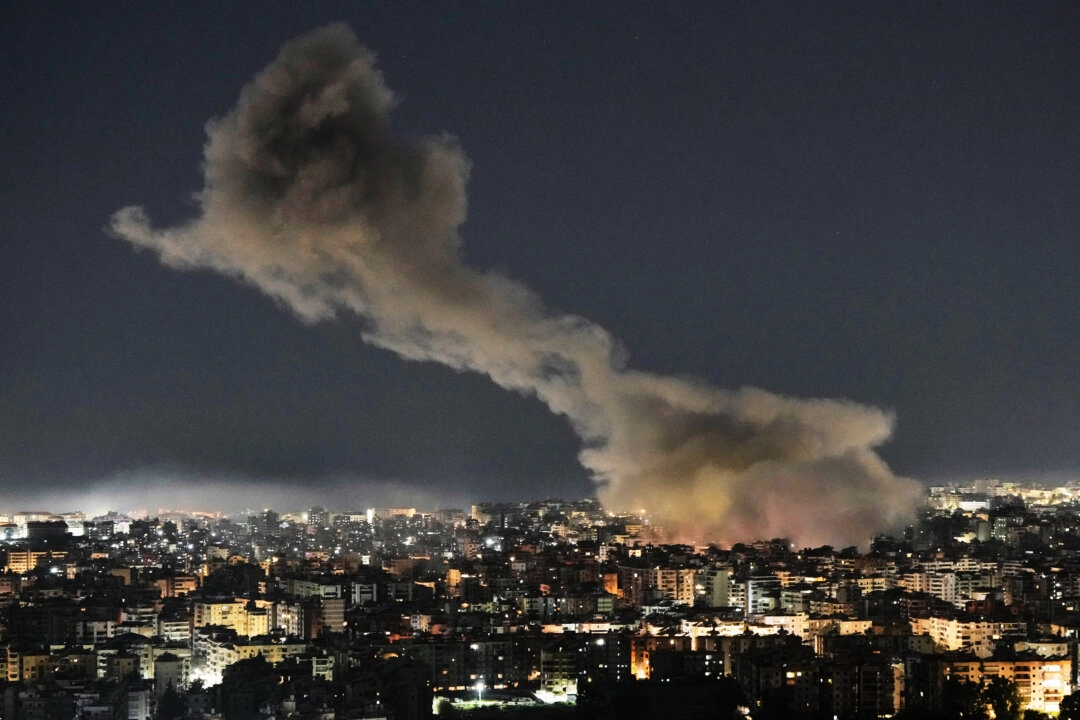
In the rapidly evolving landscape of global conflicts, the ongoing war involving Iran, the United States, and Israel has captured worldwide attention. TinHN provides a comprehensive overview of Iran war news today, detailing the sequence of events day by day, key military developments, international reactions, and potential implications. With escalating tensions in the Middle East, including strikes on critical infrastructure and diplomatic sites, the situation remains fluid. Stay informed with the latest Iran war updates, including casualty figures, strategic analyses, and economic fallout.
- Dubai News Today: Latest Updates on Tensions, Flight Resumes
- Cuba News Today 2026: Major Blackout, Regime Change, Crisis
Iran war news – Latest updates from Reuters
This detailed report draws from verified sources to offer an in-depth timeline. The conflict, codenamed Operation Epic Fury by the U.S. and Operation Roaring Lion by Israel, began as a targeted campaign against Iran’s leadership and military capabilities but has since expanded, drawing in proxies like Hezbollah and affecting Gulf states.
Iran war news – Latest updates from Fox News
Iran war news today – Live updates
Stay updated with the latest developments in the Iran conflict. We provide comprehensive coverage, including military updates, strategic analysis, and regional diplomatic shifts as they happen.
- Iran-backed Houthis in Yemen launch attack on Israel for first time in war The Washington Post
- At CPAC, the Shah’s Son Promises to “Make Iran Great Again” Mother Jones
- Thousands march in Durham No Kings protest to condemn Trump over Iran war News From The States
- Middle East crisis live: Houthis carry out ‘second military operation’ against Israel and vow to continue in coming days The Guardian
- The Daily Mail’s Elina Shirazi, On The Iran Story Western Media Isn’t Telling Yahoo News Canada
- Could Ukraine’s drone expertise serve Gulf countries? Al Jazeera
- Yemen’s Houthis Have Entered the Iran War. What You Need To Know Time Magazine
- Dollar dominance is reinforced by the oil trade, but the Iran war could give rise to the 'petroyuan' Fortune
- Iran-backed Houthis enter the month-old war and could further threaten global shipping Toronto Star
- Don't strike a deal with Iran's current leaders, opposition figure Pahlavi warns Reuters
- The Iran War is causing an energy crisis: Doomberg on Decouple and Soar Financially Pipeline Online
- IRAN WAR UPDATES: Houthi rebels claim responsibility for missile attack on Israel Yahoo News Canada
- European allies say Russia is helping Iran more than the U.S. has acknowledged, sources say CBS News
- Iran, Hezbollah launch simultaneous retaliatory strikes on Israel’s southern, northern regions Anadolu Ajansı
- Anger over Iran war adds fuel to anti-Trump 'No Kings' protests across U.S. CBC
- Russia took satellite images of U.S. airbase in days before Iranian attack, Ukraine's Zelenskyy says NBC News
- When will the Iran war end? Not soon enough, some Americans say USA Today
- Is Iran a Political Problem for Trump? Tell Me How Long the War Lasts. The New York Times
- Iranian expats say UAE canceled their residency visas, leaving many stranded ایران اینترنشنال
- U.S. underestimated Iran, says military analyst on one-month mark of Iran war CTV News
Middle East crisis and oil impact
Real-time alerts on the Iran war and the escalating global energy crisis. Get instant updates on oil supply disruptions, surging fuel costs, and international efforts to stabilize the markets as the conflict reshapes the global economy.
- Yemen’s Houthis Have Entered the Iran War. What You Need To Know Time Magazine
- Dollar dominance is reinforced by the oil trade, but the Iran war could give rise to the 'petroyuan' fortune.com
- Houthis enter Iran war and launch missiles against Israel as Britons warned of FURTHER oil price rises GB News
- Energy fallout from Iran war signals a global wake-up call for renewable energy Daily Herald
- 'You're going to run the strait': The financial incentive for braving Iran's blockade Australian Broadcasting Corporation
- Market Sell-Off Breaking Hearts; What To Do Now Investor's Business Daily
- Dread deepens among U.S. allies in Asia over a protracted Mideast war The Washington Post
- Does the War in Iran Boost US Oil Giants? GreekReporter.com
- War, oil and the dollar: The war comes home. Iran War Briefing #26 Counterfire
- Iran has a new demand to end the war – and it could bring in billions CNN
- Oil has surged since the Iran conflict – but gas prices may not be done rising Fox Business
- Worried about Strait of Hormuz inflation to come? The world economy has one word for you: Plastics CNBC
- BlackRock's Larry Fink says oil could drop to $40 if the Iran war ends right — or stay near $150 for years Yahoo Finance
- BlackRock's Larry Fink says oil could drop to $40 if the Iran war ends right — or stay near $150 for years. Which should you prepare for? moneywise.com
- How the big oil and gas CEOs think the Iran war supply disruption will play out CNBC
- BP Flags Iran War Oil Shock And What It May Mean For Investors Yahoo Finance
- Iran war's impact on oil prices drags down markets again Detroit Free Press
- Yemen's Houthis launch Israel strike, the first time since the U.S.-Israel war began CNBC
- Fears of a prolonged oil shock grow as Iran war lurches into its second month MarketWatch
- Gas prices are climbing, but who profits from the conflict? | Opinion The Providence Journal
Day-by-Day Timeline of the Iran War
Below is a detailed chronology of events, structured with the most recent day first for quick access to the latest developments. This timeline incorporates the latest Iran war news today, focusing on military actions, casualties, and diplomatic maneuvers.
Iran War News last week
The 2026 Iran War (US-Israel vs. Iran) is now in its third week. US-Israeli strikes continue to degrade Iranian military, missile, drone, and air defense capabilities. Iranian attacks on the Gulf have decreased in volume but persist, with high interception rates. Civilian casualties, displacement, and economic disruption (oil, shipping via Strait of Hormuz) are rising.
| Date | Key Event | Details | Impact / Notes |
|---|---|---|---|
| 16 March 2026 (Today) | Heavy Iranian missile strikes; Dubai airport incident; continued US-Israeli bombing | Iran launches one of its heaviest 24-hour missile waves. Fire near Dubai fuel tank after drone-related incident → temporary flight suspensions at DXB. New strikes reported in Tehran, Hamadan, Isfahan. Trump demands coalition to secure Strait of Hormuz. | Flights disrupted; ongoing escalation. Iran rejects immediate deal; war shows “no signs of ending”. |
| 15 March 2026 | Iran fires barrages at Israel + Gulf; US/Israel expand strikes; Sejjil missile claimed | 7+ Iranian missile barrages hit Israel (cluster munitions cause minor injuries/fires in Tel Aviv area, Ramla, Bnei Brak). Gulf interceptions (UAE: 4 missiles + 6 drones; Saudi, Kuwait, Bahrain report interceptions). Israel/US strike western/central Iran, targeting missile production, air defenses, command sites. Iran claims first Sejjil ballistic missile use. | Injuries in Israel; Gulf attacks continue but volume down 90-95%. Civilian damage in Iran (42,000+ sites reported hit). |
| 14 March 2026 | Iranian drone/missile wave; fire at UAE oil facility; interceptions | UAE intercepts 9 ballistic missiles + 33 drones. Drone strike sparks fire at Fujairah oil hub. Attacks on Kuwait airport/airbase. Iran accuses US of using UAE ports to strike Kharg Island (Iran oil terminal) and urges evacuation of 3 major UAE ports. | Oil operations disrupted in UAE; 6 deaths + 141 injuries in UAE since war start. Regional tension rises. |
| 13 March 2026 | Multiple Iranian barrages; Gulf & Israel impacts; US-Israeli strikes on infrastructure | Iran launches 7 missile barrages at Israel (impacts in Shoham, Rishon Lezion, Mishmar Hashiva). Gulf: UAE intercepts 7 missiles + 27 drones; Saudi 51 drones; Oman drone kills 2 workers; Kuwait detects missile. US/Israel hit Iranian security, electronics, aluminum sites, air defenses in Tehran province. | ~28 residential impacts in Israel since start. Iranian projectile volume down sharply. Humanitarian crisis grows (3.2M displaced). |
| 12–13 March 2026 | Iran retaliation peaks in some areas; new Israeli strikes | Iran fires at Israel (including near Jerusalem/Western Wall earlier) and Gulf. US-Israeli campaign targets missile launchers, drone bases, air defenses, industrial zones. New Supreme Leader Mojtaba Khamenei issues first statement vowing continued resistance. | High interception rates in Gulf (~94%). Strikes degrade Iranian capabilities; fractures reported in Iranian armed forces. |
| 10–11 March 2026 | Sirens across Israel; Iranian strikes breach defenses; ongoing Gulf attacks | Missiles/drones hit Israel (some evading interception, causing fatalities/damage). Gulf states (UAE, Saudi, etc.) report interceptions. US/Israel continue degrading missile/drone production. | Civilian casualties mount; oil/shipping volatility. Iran has fired ~2,000 projectiles at Gulf since late Feb. |
| 9–10 March 2026 | Reduced but persistent Iranian attacks; US-Israeli degradation campaign | Iran targets Gulf (UAE intercepts 12 missiles + 17 drones on ~9 March). Israel destroys launchers, strikes Esfahan missile complex, Ahvaz drone base, etc. Volume of Iranian attacks drops significantly. | Iranian missile/drone production “functionally defeated” per US officials. Regional economies rattled; calls for de-escalation. |
Middle East News Update – March 10-12
Military Developments (March 10–12)
- Strait of Hormuz Conflict: On March 10, the U.S. military (CENTCOM) reported destroying 16 Iranian mine-laying vessels near the Strait of Hormuz. Iran has been attempting to block the waterway using small craft to deploy naval mines, leading to a virtual halt in commercial shipping through the Persian Gulf.
- Intensified Strikes on Infrastructure: U.S. Defense Secretary Pete Hegseth described March 10 as the “most intense day of strikes” yet. Targets included missile production facilities in Isfahan, IRGC bases in Sanandaj and Khorramabad, and naval assets in Bandar Abbas.
- Iranian Retaliation: The Revolutionary Guard launched salvos of ballistic missiles on March 10 targeting Israeli cities, including Tel Aviv, Bnei Brak, and Ramat Gan, as well as U.S. military installations in the region. Israel reported civilian casualties and significant property damage in the central region.
- Energy Sector Pressure: Reports on March 11 indicated that the U.S. has urged Israel to avoid targeting Iran’s oil and energy infrastructure directly, reportedly to maintain the possibility of future cooperation and to stabilize global oil prices, which have spiked since the war began.
Political and Domestic Impact
- Leadership Transition: Following the assassination of Ali Khamenei, his son Mojtaba Khamenei has been named the new Supreme Leader. Analysts describe him as a hardliner likely to pursue aggressive retaliation.
- Internal Crisis in Iran: A nationwide internet blackout in Iran has reached over 240 hours, severely disrupting communication and public services. The WHO has also warned of “black rain” and toxic air quality in several provinces following strikes on industrial and oil facilities.
- Regional Instability: Fighting has spilled heavily into Lebanon, where Hezbollah carried out its highest number of daily attacks (31 waves) on March 10. Simultaneously, the Israeli Air Force has launched strikes in Beirut.
Humanitarian and Global Statistics
| Category | Reported Impact (as of March 11) |
| Casualties (Iran) | Over 3,000 military personnel; 104 reported in a single day (March 10). |
| Casualties (Israel) | 14 civilians killed and over 2,300 injured since the start of the war. |
| Infrastructure | 65 schools and 32 medical facilities in Iran damaged. |
| Energy | Oil production in the UAE and Kuwait has been cut due to the Hormuz blockage. |
Iran War News Update – March 8 & 9
As of latest reports on March 9 morning, war now in Day 10–11 since it began Feb 28 with U.S.-Israeli Operation Epic Fury:
- Iran has named Mojtaba Khamenei to succeed his slain father Ali Khamenei as supreme leader, signalling that hardliners remain in charge.
- Trump’s reaction: Called it “unacceptable” and warned Mojtaba “is not going to last long” without U.S. approval. Israel threatened to target any successor.
- Fresh missile and drone strikes by Israel and Iran reverberated across the Middle East as the war entered its 10th day. The Israeli military said on Monday it had begun a “wide-scale wave of strikes” in Tehran, Isfahan and southern Iran after a man was killed in an airstrike fired at central Israel earlier. The Israeli military also said Monday that it had begun targeting Al-Qard Al-Hassan, a US-sanctioned financial organisation that Israel has accused of financing the Iran-backed Hezbollah, in the southern suburbs of Beirut.
- Israeli strikes on Lebanon: Heavy attacks on Beirut (including a hotel targeting IRGC Quds Force commanders) and southern Lebanon — at least 100 killed in 24 hours, total Lebanese deaths now 394 (including 83 children).
- Iranian retaliation: Launched new waves of ballistic missiles (Khorramshahr, Fatah, Khyber, Qadr types) toward Israel shortly after naming the new leader. Sirens sounded in Tel Aviv; some impacts reported. Also drone/missile attacks on Gulf states.
- The war has sent oil prices surging and Asian stock markets into a nosedive. Global oil prices rose past $100 (£74) a barrel for the first time since 2022 as fallout from the war continues to wipe 20m barrels of oil from the market each day.
Middle East War News Today by March 7, 2026
The US–Israel–Iran war has entered its second week with no signs of de-escalation. Joint US and Israeli airstrikes continue to pound Iranian military and infrastructure targets, while Iran maintains retaliatory ballistic missile and drone attacks across the region.
- Multiple waves of Israeli airstrikes, involving more than 80 fighter jets, targeted Tehran overnight and into Saturday.
- US Central Command reports over 3,000 targets struck since the operation began, including 43 Iranian warships.
- Iran launched several salvos of ballistic missiles, including advanced models such as the Khorramshahr-4 and Fattah hypersonic variants.
- Most missiles were intercepted by Israeli, US, and Gulf air defenses, but explosions and air-raid sirens were reported across the region.
- Iran’s President Masoud Pezeshkian issued a public apology to neighboring Gulf states for unintended strikes, stating Iran will suspend attacks on neighbors unless they serve as launchpads for aggression against Iran.
- President Donald Trump: “Today Iran will be hit very hard.” He reiterated the demand for unconditional surrender, warning that previously untargeted “areas and groups of people” are now under consideration for “complete destruction.” Trump described the campaign as potentially lasting 4–6 weeks and stated the US has sufficient munitions.
- Israeli Prime Minister Benjamin Netanyahu: Israel will continue striking “with all our might” and promised “many surprises” in the next phase of the war.
- Iranian President Masoud Pezeshkian: Dismissed Trump’s surrender demand as “a dream” and vowed Iran “will never surrender,” while apologizing to Gulf neighbors.
U.S. forces have struck over 3,000 targets in the first week of Operation Epic Fury, and we are not slowing down. pic.twitter.com/Nqn30feTQA
— U.S. Central Command (@CENTCOM) March 7, 2026
Iran War News Today by March 6
The US–Israel–Iran war continued with intense military activity on March 6. Joint US and Israeli forces conducted widespread airstrikes across Iran, focusing on both military infrastructure and the regime’s internal security apparatus, while Iran launched retaliatory missile and drone attacks on Israel and several Gulf states. The conflict also escalated on the Lebanese front against Hezbollah.
- Israel deployed more than 80 fighter jets in a large-scale wave of airstrikes targeting Iranian military and government sites.
- Heavy overnight bombardment hit Tehran and multiple provinces, with massive explosions and fires reported in eastern and western districts of the capital.
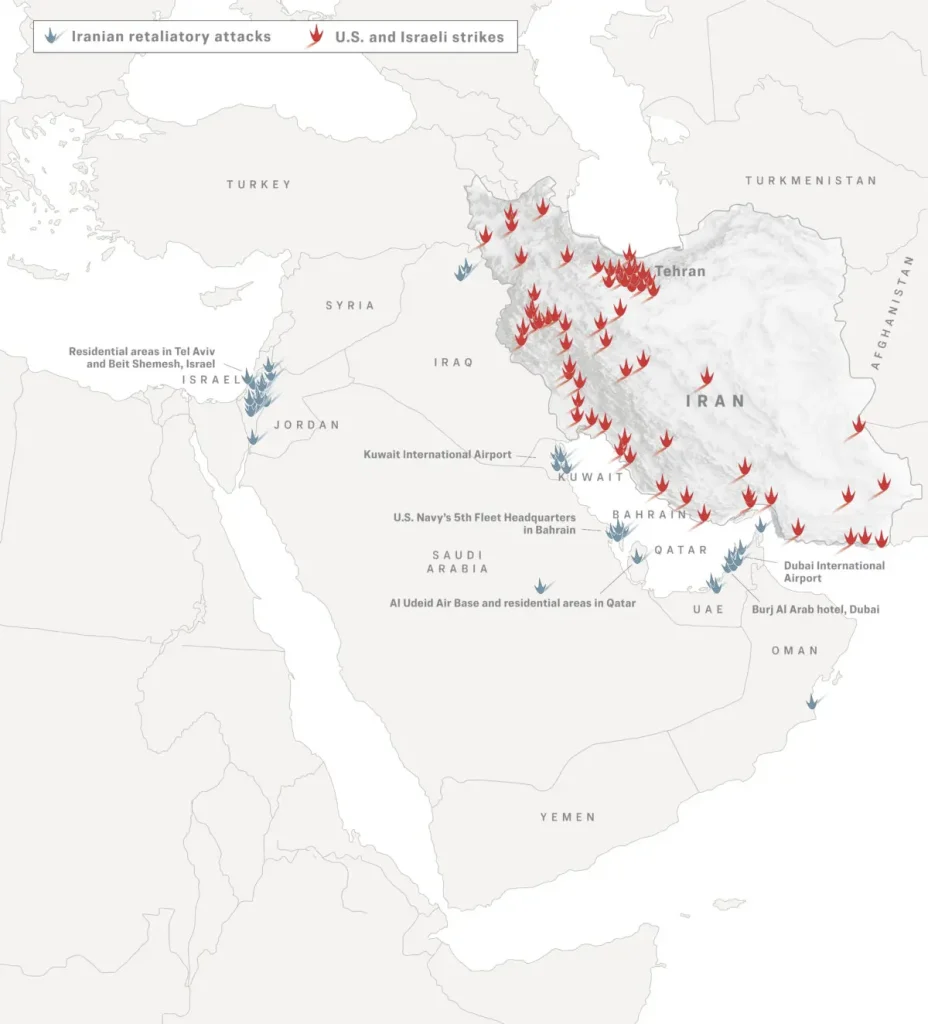
- Iran fired salvos of ballistic missiles and drones at Israel (triggering air-raid sirens and shelter orders in Tel Aviv and other cities) and multiple Gulf nations, including Saudi Arabia (Shaybah oil field – 16 drones intercepted), Qatar, Bahrain, and the UAE (including areas near Dubai International Airport).
- Explosions and interceptions were reported across the Gulf, with loud blasts heard in several cities.
- Pro-Iranian militants claimed a drone attack near a hotel in Erbil, Iraqi Kurdistan, targeting US personnel.
- Israel intensified airstrikes on Hezbollah targets, including the Mar Mikhael neighborhood in Beirut’s southern suburbs.
- Internet blackouts and widespread fear reported inside Iran; streets deserted, residents hiding or fleeing.
U.S. forces aren't holding back on the mission to sink the entire Iranian Navy. Today, an Iranian drone carrier, roughly the size of a WWII aircraft carrier, was struck and is now on fire. pic.twitter.com/WyA4fniZck
— U.S. Central Command (@CENTCOM) March 6, 2026
Middle East War News Today by March 5, 2026
As the US-Israel joint military campaign against Iran—now dubbed Operation Epic Fury—enters its sixth day on March 5, 2026, the conflict shows no signs of abating. Overnight and early morning hours brought a fresh wave of escalations, with explosions lighting up the skies over Tehran and other Iranian cities, Iranian missile barrages targeting Israel, and significant political developments in Washington. Here’s a chronological breakdown of the most critical events reported in the last 24 hours:
- Early Thursday morning (March 5 local time in Israel/Iran): Iran launched another major wave of ballistic missiles toward Israel, triggering widespread air raid sirens across central Israel, including Tel Aviv and surrounding areas. Israel’s multi-layered defense systems, including Iron Dome, David’s Sling, and Arrow, intercepted the majority of incoming projectiles. Interceptors lit up the night sky in dramatic fashion, but some reports indicate limited impacts in populated zones. No immediate casualty figures from this specific barrage were confirmed, though overall Israeli deaths from Iranian strikes since the conflict began stand at 12, with over 1,200 injuries.
- Overnight US-Israeli bombardment intensifies: Joint US and Israeli air forces conducted what Israeli officials described as the 11th major wave of strikes on Tehran and other targets. Intense explosions rocked the Iranian capital, with large plumes of smoke and flames visible across multiple districts. Strikes also hit Sanandaj (in Kurdistan province), where a media center and radio/television facilities were targeted, alongside other military infrastructure. Footage from Iranian and international sources showed widespread fires and destruction in urban areas. The Iranian Red Crescent reported that at least 105 civilian sites have been hit since the campaign began, contributing to a rising civilian toll.
"100 Hours" of Operation Epic Fury. pic.twitter.com/XW5ZnRAJJL
— U.S. Central Command (@CENTCOM) March 4, 2026
- Death toll surpasses 1,000 in Iran: According to the Iranian Red Crescent and other sources, the total number of people killed in US-Israeli strikes now exceeds 1,045 (with some estimates from human rights groups placing civilian deaths alone above 1,000). The figure includes both military personnel and civilians, with strikes continuing to target IRGC command centers, missile sites, and leadership facilities.
- US Senate blocks limit on Trump’s war powers: In a key political development late Wednesday (US time), the Senate voted 53-47 against a procedural motion to curb President Donald Trump’s authority to continue the air campaign without further congressional approval. Republican senators largely held the line, allowing the administration to maintain unrestricted military operations. Defense Secretary Pete Hegseth emphasized that the US is “accelerating, not decelerating,” describing the campaign as “just getting started” and confirming additional assets are en route to the region.
- Iran strikes ‘separatist forces’ in Iraq’s Kurdistan: Iranian forces reportedly launched attacks on what they described as separatist groups in northern Iraq, potentially in response to reported Kurdish fighter activity (with possible US backing) targeting Iranian positions. This marks a further widening of the conflict beyond direct US-Israel-Iran engagements.
- Broader regional ripples continue: The war’s effects spread far afield, including NATO intercepting an Iranian ballistic missile headed toward Turkey and the prior sinking of an Iranian warship (IRIS Dena) by a US submarine in the Indian Ocean off Sri Lanka (with at least 80 killed). Shipping through the Strait of Hormuz remains severely disrupted, driving oil prices higher amid global energy concerns.
The effort to eliminate the Iranian regime's mobile missile launch capabilities continues. We are finding and destroying these threats with lethal precision. pic.twitter.com/AkGRYOjnOz
— U.S. Central Command (@CENTCOM) March 5, 2026
Iran War News Today by March 4
As of March 4, 2026, the conflict shows no signs of abating. Here’s the latest from today:
- A US submarine sank an Iranian warship off Sri Lanka on Wednesday, killing at least 80 people.
- Thousands of Iraqi Kurds launch ground offensive into Iran, US official tells Fox News
- President Donald Trump said the United States is in a “very strong position now” in the war with Iran following a series of U.S. and Israeli strikes targeting the country’s military capabilities.
- The Israeli Air Force carried out wide-scale strikes Wednesday targeting dozens of ballistic missile assets in western and central Iran, the Israel Defense Forces said.
- Ongoing Strikes in Tehran: Explosions reported in eastern Tehran from a new Israeli “broad wave” of attacks targeting government and military sites. Destruction visible at the Assembly of Experts building in Qom, the body responsible for selecting Iran’s next Supreme Leader following Khamenei’s assassination.
- Air Combat Milestone: An Israeli F-35I stealth fighter shot down an Iranian Yak-130 combat trainer/light attack aircraft over Tehran in what marks a historic dogfight involving fifth-generation jets.
- Iranian Retaliation: An Iranian missile struck a U.S. military base in Qatar housing American troops; no casualties reported so far. Additional IRGC missile and drone attacks targeted U.S. bases in the UAE and other Gulf locations.
- Leadership Succession Threats: Iran is nearing the appointment of a new Supreme Leader amid the leadership vacuum. Israel’s Defense Minister issued a stark warning that any successor appointed to continue the regime’s policies would be targeted for elimination.
- Economic and Global Impact: The Strait of Hormuz remains closed, with oil prices extending gains amid fears of prolonged disruption. U.S. President Trump pledged to deploy the Navy to escort tankers for safe transit if needed, while threatening to cut off all trade with Spain over denied access to military bases for operations.
- Casualties Update: Iranian Red Crescent and other sources report over 787 deaths from strikes; U.S. military losses remain at six troops killed earlier in the conflict. Civilian toll in Iran and affected areas likely in the thousands.
- International Responses: The UN continued calls for de-escalation amid fourth- and fifth-day violence. Democratic U.S. senators expressed alarm after briefings, fearing a lack of clear objectives and potential for U.S. ground troops. European nations braced for economic fallout.
Update from CENTCOM Commander on Operation Epic Fury: pic.twitter.com/epEohq64Vf
— U.S. Central Command (@CENTCOM) March 3, 2026
20 Iranian Ships Hit Since Start of Conflict
The U.S. military has sunk or struck 20 ships belonging to the Iranian regime since the start of the war with Iran.
While the Iranian regime indiscriminately targets civilians with missiles and drones, U.S. forces continue to aggressively hunt and destroy Iranian missile launchers with precision. pic.twitter.com/1RIhMcg0Jm
— U.S. Central Command (@CENTCOM) March 4, 2026
“Last night, CENTCOM added a Soleimani-class warship to the list,” U.S. Central Command said in reference to one of Iran’s newest naval vessels.
U.S. forces have struck or sunk to the bottom of the ocean more than 20 ships from the Iranian regime. Last night, CENTCOM added a Soleimani-class warship to the list. pic.twitter.com/KgW8cS726P
— U.S. Central Command (@CENTCOM) March 4, 2026
Israel Vows to Eliminate Anyone Chosen to Replace Khamenei
Israeli Defense Minister Israel Katz said in a March 4 post on X that whoever is appointed to replace deceased Iranian leader Ayatollah Ali Khamenei “will be an unequivocal target for elimination.”
“[Prime Minister Benjamin Netanyahu] and I have instructed the IDF to prepare and act by all means to carry out the mission as an integral part of the objectives of Operation ‘Lion’s Roar,’” Katz said, using Israel’s term for the military offensive against Iran and its proxies.
“We will continue to act with full force, together with our American partners, to crush the regime’s capabilities and create the conditions for the Iranian people to overthrow it and replace it,” Katz added.
Iranian Warship Sinks off Sri Lanka
One of Iran’s newest naval vessels, the frigate IRIS Dena, has sunk off the southern coast of Sri Lanka, with dozens of sailors rescued and several bodies recovered, Sri Lankan officials said on March 4.
Sri Lankan Foreign Minister Vijitha Herath told Parliament the ship sent a distress call around 5:08 a.m. local time. About 180 people were believed to be aboard, with roughly 30 sailors seriously injured.
Sri Lanka’s navy and air force launched a joint search-and-rescue operation after the distress signal, rescuing 32 survivors so far.
Iran War News Today by March 3
March 3 saw the conflict spiral further, with strikes on diplomatic sites, cultural/clerical landmarks, and expanded regional involvement.
- U.S.-Israeli Operations: A “broad wave” of strikes pounded Tehran, including the central command headquarters and presidential complex. An Israeli F-35 achieved the first combat kill of an Iranian jet in Tehran airspace. Ground operations reported in Lebanon against Hezbollah.
- Iranian Actions: IRGC launched over 40 missiles at regional targets; drones struck the U.S. Embassy in Riyadh and the U.S. Consulate in Dubai. Hezbollah intensified attacks into northern Israel.
- Nuclear and Infrastructure Concerns: Damage reported at Natanz nuclear site, though no radiation leaks confirmed by IAEA.
- Casualties and Disruptions: Total Iranian deaths surpassed 1,000 in some estimates; embassies closed across multiple countries. Qatar suspended LNG production temporarily. Oil prices soared over 40% since the war’s start, global shares slid.
- Political Debate: Trump defended the campaign as necessary to prevent nuclear threats, while critics questioned long-term strategy and objectives.
Iran War News Today by March 2
By March 2, the war expanded beyond Iran’s borders, involving Lebanon, Gulf states, and proxy forces.
- Strikes on Iran: U.S.-Israeli forces degraded air defenses over western Iran and Tehran, with more than 2,000 bombs dropped cumulatively.
- Iranian Retaliation: Iran officially closed the Strait of Hormuz, threatening vessels. Waves of missiles and drones targeted Israel and U.S. bases; Hezbollah formally joined by firing into northern Israel.
- New Fronts: Energy facilities hit in Qatar and the UAE. Conflict spread to Lebanon with Israeli strikes on Hezbollah positions.
- Casualties: Iranian deaths reached approximately 787; U.S. troop losses at six.
- Diplomatic Moves: Trump warned of “harder hits” ahead; Iran sought support from Russia and China. European nations mobilized to protect interests in Cyprus and elsewhere.
Middle East war 2026 – Latest news from Sky
Iran War News Today by March 1
March 1 brought confirmation of a major blow to Iran: the death of Supreme Leader Ali Khamenei in an Israeli airstrike. This event triggered national mourning and intensified retaliation.
- Leadership Vacuum: Iranian state media announced Khamenei’s death, declaring 40 days of mourning and a 7-day national holiday. An Interim Leadership Council assumed control, with the IRGC stepping up operations.
- Continued Strikes: U.S.-Israeli forces conducted around 2,000 strikes by day’s end, targeting air defenses and missile sites. The IAEA reported no damage to nuclear installations initially, though Iran claimed one site was hit.
- Iranian Counterattacks: Iran launched over 500 ballistic missiles and 2,000 drones, hitting U.S. and allied targets. Strikes reached as far as Cyprus and Sri Lanka.
- Casualties: Iranian deaths surpassed 500, including civilians from a strike on a girls’ school that killed over 100. U.S. losses included three soldiers in Kuwait.
- Global Fallout: Oil prices surged further, and airlines grounded flights to the region. Trump indicated the operation might last a month, not ruling out ground troops.
Day 1: February 28, 2026 – The Outbreak of Conflict
The war ignited on February 28, 2026, with coordinated U.S.-Israeli airstrikes targeting Iranian leadership, nuclear sites, and military installations. Israel and the U.S. aimed to induce regime change and address nuclear concerns. Key events included:
- Initial Strikes: U.S. and Israeli forces bombed sites across Iran, focusing on suppressing air defenses, degrading retaliation capabilities, and disrupting command structures. Reports indicate strikes on Tehran’s government buildings and missile silos.
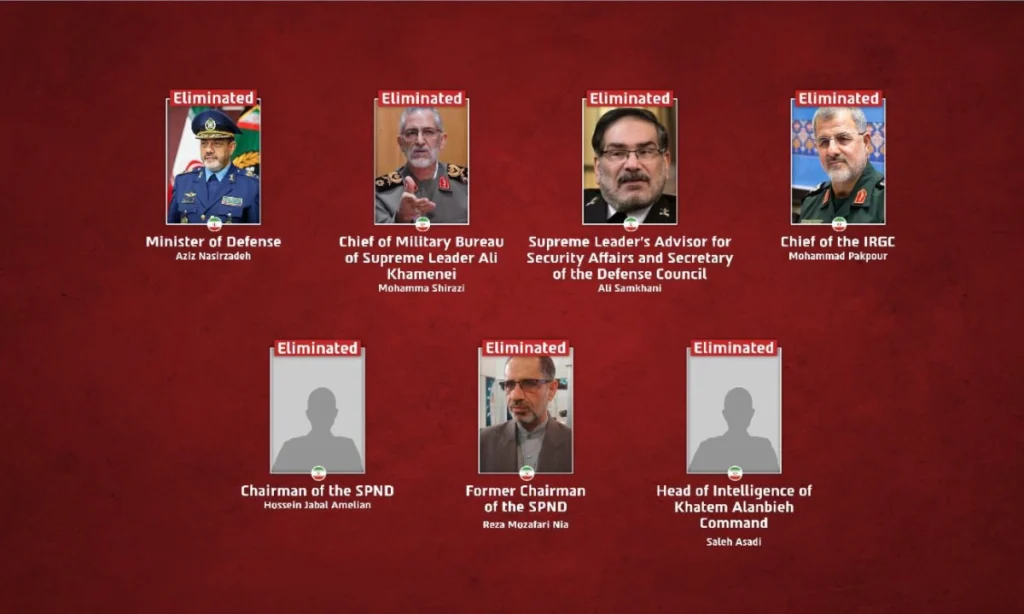
- Assassinations: Several high-profile Iranian officials were killed, setting the stage for chaos. This included targeted hits on military commanders.
- Iranian Response: Iran immediately retaliated with drone and missile attacks on U.S. bases in the Gulf. The Islamic Revolutionary Guard Corps (IRGC) declared a state of war.
- Casualties and Impact: Early reports estimated dozens of deaths in Iran, with civilian infrastructure affected. Global markets reacted with oil prices jumping 15% due to fears over the Strait of Hormuz.
- International Reactions: President Trump stated that renewed nuclear talks would be “much easier” post-strikes. The UN called for de-escalation, while Russia and China condemned the attacks as provocative.
This day marked the swift transition from diplomatic standoff to full-scale war, with over 500 strikes reported in the first 24 hours.
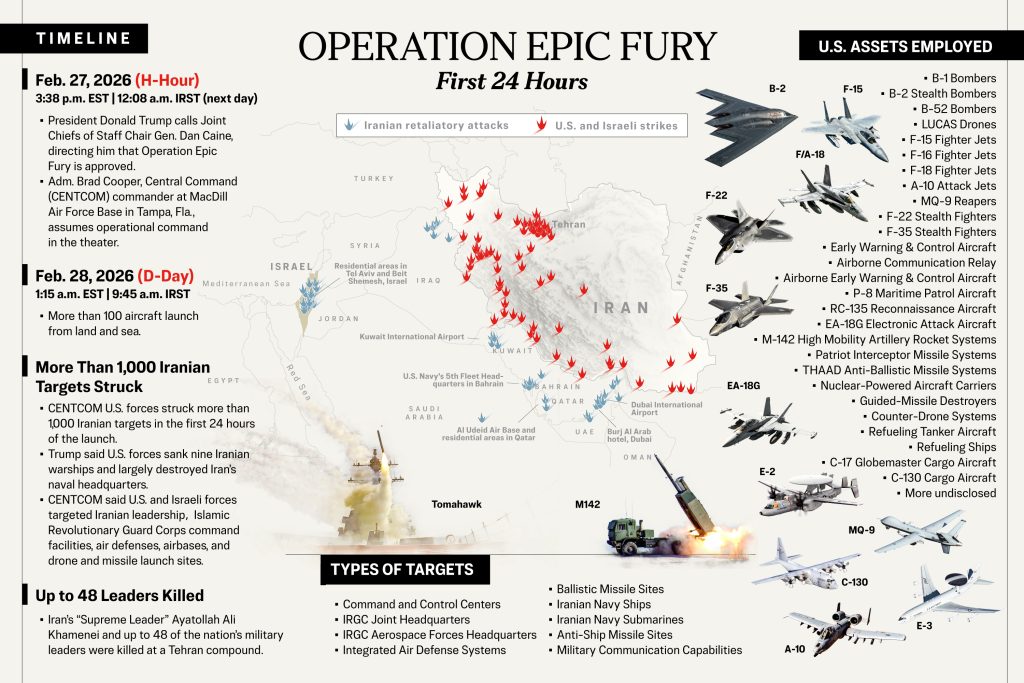
Key Events: The 2026 Iran War
| Date | Event | Key Details |
| Mar 9 | New Offensive & Market Volatility | Iran launches fresh ballistic missile barrages; oil prices spike to $120/barrel; G7 decides not to tap reserves yet. |
| Mar 8 | New Leadership in Iran | Mojtaba Khamenei is officially named the new Supreme Leader. UAE confirms it is “at war” after missile interceptions. |
| Mar 6–7 | Targeting the “Morality Police” | Coalition strikes shift to internal security, hitting “Morality Police” and Basij HQs in Isfahan and Tehran to support internal dissent. |
| Mar 5 | Air Superiority Established | The US and Israel establish effective air control over western Iran. Major strikes destroy the Azadi Stadium and military airfields. |
| Mar 4 | NATO Involvement | NATO forces intercept an Iranian ballistic missile over Turkish airspace; Israel intensifies the “Northern Front” against Hezbollah in Lebanon. |
| Mar 3 | Leadership Vacuum | Strikes destroy the building where the Assembly of Experts was to meet, delaying the selection of a successor to Khamenei. |
| Mar 2 | Strait of Hormuz Closed | Iran officially closes the Strait, halting 20% of global oil flow. Hezbollah enters the war with massive rocket barrages. |
| Mar 1 | Regional Retaliation | Iran strikes US bases and allied infrastructure in UAE, Qatar, and Bahrain. A drone hits the RAF Akrotiri base in Cyprus. |
| Feb 28 | Operation “Epic Fury” Begins | US and Israel launch ~900 strikes in 12 hours. Supreme Leader Ali Khamenei is assassinated in his Tehran compound. |
Background: How the Iran War Began
Before diving into the day-by-day breakdown, it’s essential to understand the prelude to this conflict. Tensions between Iran and the U.S.-Israel alliance have simmered for years, rooted in Iran’s nuclear program, support for proxy militias, and regional influence. In January 2026, amid Iran’s internal crackdowns following the 2025-2026 protests, the U.S. signaled airstrikes as an option while preferring diplomacy. Negotiations faltered, leading to the joint strikes on February 28, 2026.
The war’s stated goals include regime change, degrading Iran’s nuclear and ballistic missile programs, and neutralizing its armed forces. Iran has responded with vows of retaliation, closing the Strait of Hormuz and launching widespread attacks. As of today, over 2,000 targets have been hit by U.S.-Israeli forces, with Iranian casualties exceeding 787, including civilians. The conflict has disrupted global oil supplies, spiked energy prices, and prompted evacuations across the region.
Global Economic Impacts
The war has triggered a “perfect storm” of energy shocks and supply chain disruptions:
1. Energy Crisis
- Price Surges: Oil prices have skyrocketed nearly 41% since the outbreak. Brent crude surpassed $110 within days and peaked near $126.
- LNG & Gas: European and Asian gas prices have surged due to the disruption of Qatari LNG shipments through the Strait of Hormuz.
- Supply Gap: With the Strait effectively closed, roughly 20% of global seaborne oil and 25% of LNG are currently stranded or diverted.
2. Shipping & Trade Disruptions
- Logistics Chaos: Major carriers like Maersk and MSC have halted Gulf shipments or rerouted around the Cape of Good Hope, adding 10–15 days to Á-Âu transit.
- Niche Shortages: The conflict has highlighted hidden chokepoints, such as Qatar’s 40% share of global helium (critical for semiconductors) and regional ammonia/nitrogen exports for fertilizers.
- Agriculture: Millions of tons of Indian basmati rice and other Asian exports are currently stuck in transit or at ports due to the high-risk zone.
3. Inflation & Financial Markets
- Stock Market Volatility: Global indexes have seen sharp declines, with the Dow Jones falling over 400 points early in the conflict.
- Inflationary Pressure: Analysts predict a sustained conflict could add 0.5% to 0.8% to global inflation, complicating interest rate cuts by the Federal Reserve and ECB.
- Aviation: Major airlines (Lufthansa, Air France) have extended flight cancellations to the Middle East, and fuel surcharges are beginning to hit passenger tickets.
4. Regional Economic Paralysis
- Tourism & Real Estate: Economic hubs like Dubai and Doha have seen hotel bookings plummet, with some analysts describing a prolonged conflict as a “catastrophe” for smaller Gulf economies.
- Iran’s Economy: Already strained by 40% inflation in 2025, Iran’s domestic economy is facing hyperinflation and severe infrastructure damage to its energy and power grids.
What Comes Next? Expert Analysis and Possible Scenarios
The US-Israel campaign has inflicted severe damage on Iran’s military infrastructure, nuclear sites, missile capabilities, and leadership—most notably the killing of Supreme Leader Ali Khamenei in the opening strikes. Yet the conflict’s endgame remains highly uncertain. Experts from think tanks like the Atlantic Council, Brookings Institution, Chatham House, and former officials such as Gen. David Petraeus emphasize that air power alone is unlikely to force regime change without significant internal upheaval or ground involvement, which the Trump administration has repeatedly ruled out.
Below are the most discussed scenarios from expert analyses across sources, ranked roughly from more peaceful/negotiated to more chaotic/escalatory:
1. Negotiated Settlement or “Venezuela-Style” Deal
Several analysts, including Brookings experts, suggest the Trump administration’s optimal outcome resembles the 2019 Venezuela model: heavy pressure forces a leadership reshuffle (e.g., an IRGC-backed pragmatist or interim council figure replaces hardliners), followed by concessions on nuclear enrichment, missile limits, and proxy abandonment in exchange for sanctions relief and oil market access. Trump has repeatedly urged Iranians to “seize control,” but officials insist this is not endless regime-change nation-building. A modified nuclear deal could emerge if a post-Khamenei figure signals flexibility, potentially within weeks if strikes continue to erode regime cohesion without full collapse. Risks: Hardliners consolidate power instead, viewing concessions as surrender.
2. Prolonged Air Campaign with Limited Regime Change
The conflict drags on for 3–8 weeks (aligning with Trump’s “four weeks” estimate in some statements), focusing on attrition rather than invasion. US/Israel achieve stated military objectives—neutralizing nuclear breakout capacity (set back months to years), destroying ~90% of missile stocks, and sinking remaining naval assets—then declare victory and wind down. Iran survives under IRGC military rule or a new supreme leader (possibly a hardliner cleric or Guards figure), becoming a weakened “garrison state” with reduced regional influence. Proxies like Hezbollah and Houthis remain degraded but active. Experts warn this leaves Iran paranoid and dangerous long-term, with no true transition to moderation.
3. Regime Survival but Internal Fragmentation
The Islamic Republic endures in a altered form, as its clerical-military system was designed to outlast individuals. An interim leadership council (per Iran’s constitution) or Assembly of Experts selects a successor amid wartime constraints, likely tilting toward IRGC dominance. No popular uprising materializes due to repression, internet blackouts, and war fatigue. The regime emerges battered—economically crippled, militarily gutted—but intact, potentially more aggressive regionally to rally nationalist support. US officials express skepticism about near-term collapse, with CIA assessments predicting hardliner replacement over opposition takeover.
4. Full Regime Collapse and Chaotic Transition
Sustained strikes, combined with pre-existing discontent (e.g., 2025–2026 protests), trigger mass unrest or IRGC splintering, leading to fragmentation or civil strife. Opposition groups attempt to fill the vacuum, but lack organization or arms. Worst-case: Bloody chaos akin to post-2003 Iraq or Libya, with warlordism, refugee waves, and risks of nuclear material leakage (though IAEA reports no radiological incidents yet). Experts like those at Chatham House and Atlantic Council caution this could widen into regional implosion, drawing in Gulf states, Turkey, or even Russia/China indirectly.
5. Escalation to Wider Regional or Global Conflict
Iran activates full “Axis of Resistance” retaliation (unleashing reserved missiles, cyber attacks, Strait of Hormuz closure), pulling in more actors. Strikes expand to US bases or allies trigger broader involvement. Some analysts warn of “forever war” quagmire if ground forces become necessary, though Trump and Hegseth reject this. Nuclear escalation fears remain speculative, as Iran’s program is heavily damaged.
Overall, most experts lean toward scenarios 1–3: a damaged but surviving regime, possibly under new hardline leadership, with the US/Israel claiming strategic success without boots-on-ground occupation. Diplomatic paths appear dim in the immediate term amid ongoing strikes, but mounting casualties (Iran >1,000 dead; Israel/US losses rising), oil price volatility, and global pressure could force de-escalation talks. Petraeus and others stress the coming days—particularly IRGC cohesion and any signs of internal fracture—will be decisive.