
The 2026 US midterm elections are scheduled for November 3, 2026, putting all 435 House seats and 35 Senate seats up for fierce competition. With the primary season now largely complete, the general election battlefield is set — and the latest forecasting models suggest Democrats enter the fall as the clear favorites in the House and competitive in the Senate.
For race-by-race Senate analysis, see our 2026 Midterm Senate Map. For primary results state by state, see our Primary Results tracker. For the top governor race of the cycle, see Hilton vs. Becerra: California 2026.
What Are the 2026 US Midterm Elections?
Midterm elections are congressional elections held at the midpoint of a presidential term — two years after the presidential election. In 2026, they take place during President Donald Trump’s second term and represent the most important political test of his presidency at this stage.
In total, all 435 seats in the House of Representatives and 35 of the 100 Senate seats are on the ballot, alongside 39 gubernatorial elections across states and territories. The winners will serve in the 120th United States Congress, convening in early January 2027.
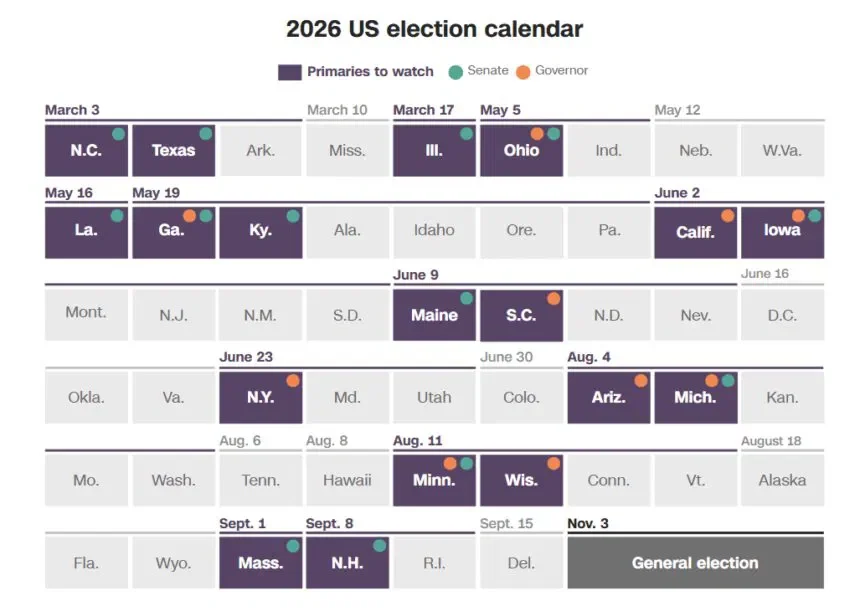
2026 Election Calendar
| Event | Date |
|---|---|
| First primaries (Texas, California, etc.) | March 3, 2026 ✅ |
| Georgia primary + runoffs | May 19 / June 16, 2026 ✅ |
| South Carolina, Maryland, NY runoffs | June 23, 2026 ✅ |
| Primary season largely complete | August 2026 ✅ |
| General Election Day | November 3, 2026 |
| New Congress sworn in | Early January 2027 |
Current Landscape: Who Controls Congress?
House of Representatives: Republicans currently hold 218 seats to Democrats’ 212, with 5 vacancies (CA-01, CA-14, TX-23, FL-20, GA-13). Democrats need a net gain of approximately 5 seats to retake the majority once vacancies are filled — though the exact threshold shifts as special elections are held.
Senate: Republicans hold 53 seats to Democrats’ 47 (including 2 independents caucusing with Democrats). Democrats need a net gain of 4 seats for a majority.
The August 2026 Forecast: Democrats Are Favored
The forecasting picture has shifted significantly since the primary season wrapped. As of August 3, 2026:
FiftyPlusOne (the intellectual successor to FiveThirtyEight’s congressional forecasting model, which was the most accurate model of the 2024 cycle):
- Democrats: 85% chance of winning the House majority
- Democrats: 55% chance of winning Senate control
- Median House forecast: 230 Democratic seats (range: 211–253)
- Median Senate forecast: 51 Democratic seats (range: 47–55)
Generic ballot (YouGov/Economist, August 1–4, 2026):
- Democrats: 43.7%
- Republicans: 38.4%
- Among independents: Democrats +12 (38.2% vs. 26.0%)
Trump approval (same poll): 41% approve, 55% disapprove — with 12% of 2024 Trump voters now disapproving of his job performance.
Why the Environment Favors Democrats
1. Trump’s Approval Is Historically Low
Trump’s approval rating has declined from 47% at inauguration to approximately 41% in early August. Among independent voters — the group that decides competitive races — it sits below 35%, a level that historically correlates with significant opposition party gains.
Critically, his economic approval is the weakest component: surveys consistently show 60%+ of Americans believe the economy is heading in the wrong direction, driven by tariff-related inflation and persistent consumer price pressure.
2. The Generic Ballot Advantage Is Substantial and Durable
A +5 to +6 point Democratic generic ballot advantage in August has historically been sufficient to produce major seat gains. The YouGov/Economist August 4 poll showing Democrats at +5.3 nationally, with a +12 lead among independents, puts the environment in genuine wave election territory.
3. Historical Patterns Compound the Pressure
In 15 of the most recent midterm cycles, the president’s party has lost House seats. Only twice has the president’s party gained House seats at midterms. The combination of historical headwinds, low approval, and a strong opposition-party generic ballot creates compounding pressure on Republican incumbents.
4. Democratic Enthusiasm Is Running Above Expectations
Key indicators of Democratic enthusiasm have surprised to the upside:
- Georgia: Democratic primary turnout exceeded Republican turnout for the first time since 2006.
- Georgia special election (April 7): Republican Clay Fuller won by only 11 points in a district Trump carried by 37 points in 2024 — a 26-point Democratic overperformance.
- Fundraising: Democratic Senate candidates are out-raising Republicans in multiple key states, most dramatically in Georgia where Ossoff has a roughly 10-to-1 cash advantage over Collins.
5. Key Senate Ratings Have Moved Toward Democrats
Since June, three Senate races have shifted meaningfully toward Democrats:
- Georgia: Sabato’s Crystal Ball → Likely Democrat (July 30)
- North Carolina: Multiple forecasters → Lean Democrat (June 11)
- Alaska: Cook Political Report → Toss-Up (July 1)
- Ohio: Sabato’s Crystal Ball → Toss-Up (June 11)
Why Republicans Could Still Outperform
The Republican case for limiting losses — or in the Senate, retaining the majority — rests on several structural realities.
1. The Redistricting Map Is Real
Republicans finished the 2026 redistricting cycle with an estimated ~17-seat structural map advantage in the House. Democrats, even with a strong national environment, must win by larger margins in individual districts to translate generic ballot leads into seat gains. This structural firewall has historically suppressed Democratic overperformance even in favorable environments.
The Supreme Court’s June 2 ruling allowing Alabama to use a redrawn map that eliminates one majority-Black district reinforced this structural edge.
2. The Senate Terrain Favors Republicans
Despite the ratings shifts toward Democrats, Republicans remain structural favorites in the Senate. Of 35 seats on the ballot, 23 are currently held by Republicans — but most are in safely red states. Democrats must nearly run the table on competitive seats (Maine, North Carolina, Alaska, Ohio) to reach the four-seat gain needed for a majority, while simultaneously holding Georgia and Michigan.
The FiftyPlusOne 55% Democratic Senate probability reflects genuine competitiveness, not dominance.
3. Economic Conditions Could Improve
Q1 2026 GDP growth came in at +2.0%, and unemployment remains historically low. For working-class voters in the industrial Midwest, the jobs picture matters as much as abstract inflation statistics. Any improvement in consumer prices between now and November — whether from supply chain adjustment, tariff modifications, or other factors — could narrow the gap meaningfully.
4. Generic Ballot vs. Map: The Translation Problem
Democrats leading the generic ballot by 5–6 points does not automatically translate into 20+ seat gains when the map is tilted. In 2022, Democrats led the generic ballot by small margins yet Republicans gained seats in the House. The 85% Democratic House forecast assumes the environment is strong enough to break through the redistricting firewall — a projection that carries real uncertainty.
Key Races to Watch
Senate (Full breakdown: 2026 Midterm Senate Map)
| Race | Current Rating | Key Dynamic |
|---|---|---|
| Georgia (Ossoff D vs. Collins R) | Lean/Likely Democrat | Ossoff leads by 4–13 pts; massive fundraising edge |
| Michigan (Open seat) | Toss-Up | Peters retirement; purple state trending R |
| Maine (Collins R vs. Platner D) | Toss-Up | Collins’ independence vs. hostile environment |
| North Carolina | Lean Democrat | Surprising shift in Trump-won state |
| Alaska (Peltola D vs. Republican) | Toss-Up | Peltola’s cross-partisan appeal + RCV system |
| Ohio (Brown D vs. Husted R) | Toss-Up | Brown’s blue-collar credibility in R-trending state |
House
The most competitive districts are now set following the primary season. Cook Political Report’s July 16 update moved several seats, with CA-45 and NY-19 now rating Likely Democrat. Key toss-up districts remain concentrated in California, New Jersey, Pennsylvania, Virginia, and Arizona — where independent voter preferences will be decisive.
Governor: California
The marquee governor race of the cycle pits Democrat Xavier Becerra against Republican Steve Hilton in California, with Becerra leading 52% to 31% in the first post-primary poll. For full analysis, see Hilton vs. Becerra: 2026 California Governor Race.
What Would a Democratic House Majority Mean?
If Democrats secure the House majority — now the most likely outcome per major forecasting models — the implications are significant:
- Committee chairmanships flip, giving Democrats power to launch investigations and subpoena administration officials.
- Legislative agenda of the White House is blocked on spending bills and major policy initiatives.
- Presidential appointments face new scrutiny as the Senate confirmation landscape shifts.
- Foundation laid for 2028, with Democrats controlling the investigative and legislative narrative heading into the next presidential cycle.
A Republican House hold — increasingly the underdog scenario — would validate Trump’s second-term agenda and set up a strong Republican position heading into 2028.
What to Watch Between Now and November 3
- August economic data: The August CPI report (due September) and jobs reports will be closely watched. Any softening in inflation could shift the political environment.
- Trump approval trajectory: Sabato’s Crystal Ball notes there is no consistent pattern for presidential approval changing significantly in the final four months before a midterm — suggesting the current ~41% approval is likely to hold through November.
- Tariff policy: Any modification to tariff policy that eases consumer prices before November would be the single most impactful thing Republicans could do to improve their electoral prospects.
- September and October advertising: Cook Political Report’s Senate and House ad tracker will show where both parties are allocating resources — a real-time signal of which races are moving.
- Early voting turnout: Democratic enthusiasm signals from primary turnout will be tested against actual general election early vote data starting in October.
Frequently Asked Questions
When are the 2026 US midterm elections? Tuesday, November 3, 2026.
Which party currently controls Congress? Republicans control both the House (218–212, with 5 vacancies) and the Senate (53–47) as of August 2026.
What are the latest forecasts for House control? FiftyPlusOne (August 3, 2026) gives Democrats an 85% chance of winning the House majority, with a median forecast of 230 Democratic seats.
What are the latest forecasts for Senate control? FiftyPlusOne gives Democrats a 55% chance of winning Senate control — meaning the Senate is genuinely competitive but leans Democratic in the current environment.
What is the generic ballot showing? As of the YouGov/Economist poll (August 1–4), Democrats lead Republicans 43.7% to 38.4% nationally, with a +12 point Democratic advantage among independents.
How many seats do Democrats need to win the House? Approximately 5 net seats, accounting for current vacancies. The exact threshold is 218 when all seats are filled.
When will official results be available? Preliminary results will come in on the night of November 3, 2026. Close races may take days or weeks to be officially certified, particularly in states with heavy mail-in voting like California.
For race-by-race Senate analysis, see our 2026 Midterm Senate Map. For primary results state by state, see our 2026 Midterm Primary Results tracker.