
Nobody gave Cape Verde a chance.
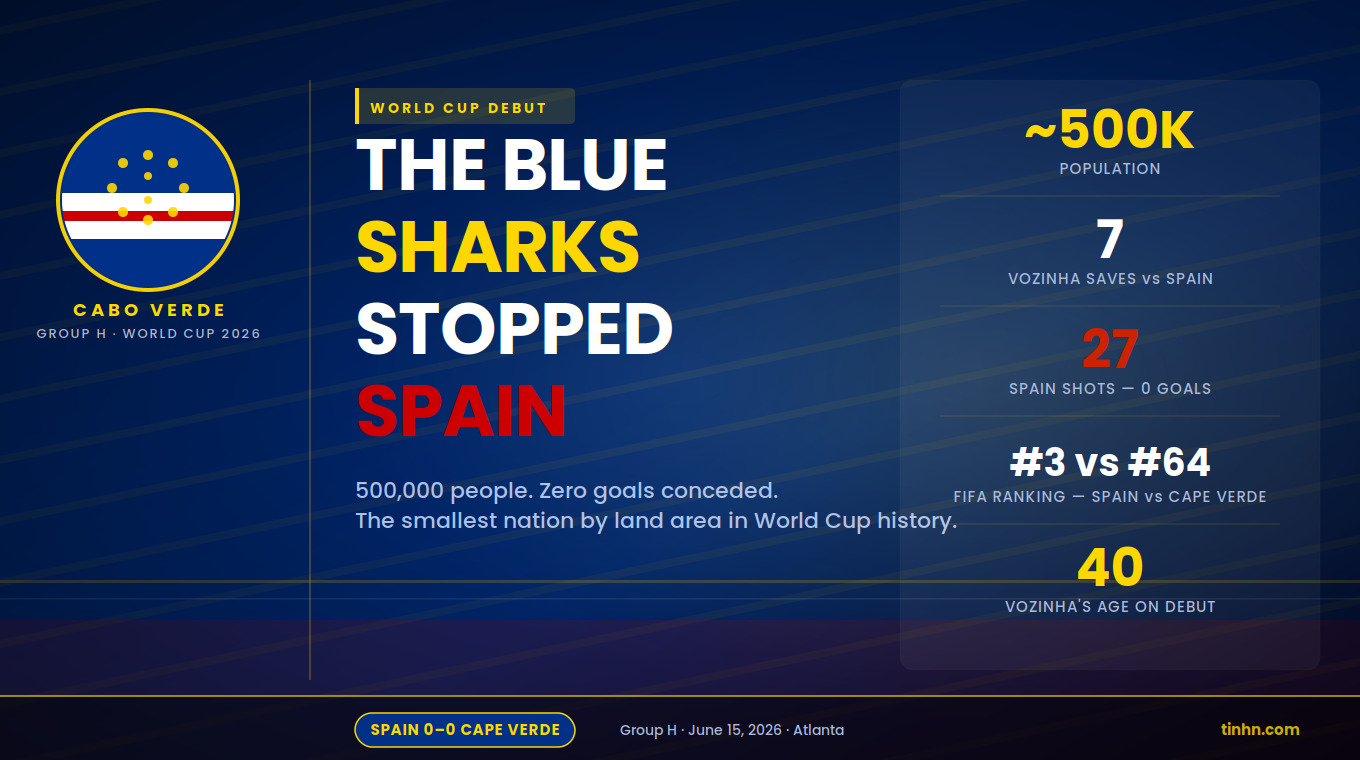
The smallest nation by land area ever to qualify for a World Cup. A volcanic archipelago of ten islands off the west coast of Africa. A population of just under 500,000 — smaller than the city of Tucson, Arizona. FIFA ranking: 64th. Opponents in Group H: reigning European champions Spain, South American giants Uruguay, and experienced World Cup campaigners Saudi Arabia.
On June 15, 2026, in Atlanta’s Mercedes-Benz Stadium, Cape Verde walked out for their first-ever World Cup match — and held Spain to a goalless draw.
Twenty-seven Spanish shots. Seven Cape Verdean saves. One of the most remarkable results in modern World Cup history.
WC 2026 – M13: Spain vs Cape Verde full Highlights
Who Are Cape Verde?
Cabo Verde — known in English as Cape Verde — is an archipelago of ten islands situated in the Atlantic Ocean, roughly 570 kilometres off the coast of Senegal. Colonised by the Portuguese in the 1460s and uninhabited before European arrival, the islands gained independence in 1975.
The national football team began its journey in 1978, three years after independence. For decades, they were a footnote in African football — capable enough to qualify for Africa Cup of Nations tournaments, but far from the world stage.
That all changed under coach Bubista.
The Man Who Built the Blue Sharks
Pedro Leitão Brito — universally known as Bubista — played for Cape Verde during the 1990s and early 2000s before transitioning into coaching. He took over the national team in 2020, inheriting a side with potential but lacking a clear identity.
What Bubista built over the next five years is one of African football’s most remarkable transformations. Named CAF Coach of the Year in 2025, he gave the Blue Sharks a philosophy centred on defensive organisation, disciplined shape, and lethal counter-attacks. He also tapped into something the squad already had in abundance: diaspora quality.
Cape Verde’s 26-man World Cup squad includes players based across 14 different countries — Portugal, Spain, France, Germany, the Netherlands, Cyprus, Slovakia, and beyond. All 11 starters in their decisive qualifying win over Eswatini were foreign-based. This is a team built from the Cape Verdean global community, with roots everywhere and loyalty to one flag.
In the CAF qualifying campaign, Bubista’s side finished top of Group D with 23 points — seven wins, two draws, one defeat — ahead of Cameroon, one of Africa’s most established football nations. They clinched qualification with a composed 3-0 home win over Eswatini, confirming their place in North America with a performance that reflected everything their manager had built: structure, calm, and clinical finishing when the moment arrived.
The Key Players
Vozinha (GK) — Born Josimar José Évora Dias, aged 40, plays for GD Chaves in the Portuguese second division. His nickname — “Vozinha,” meaning “Little Voice” — belies what he does on a football pitch. Against Spain, he made seven saves, many at close range, to earn the Blue Sharks their historic point. Afterwards, he wept. His mother couldn’t attend because her visa application didn’t arrive in time. At 40 years and 12 days old, he became the oldest player to appear in a nation’s World Cup debut fixture — breaking a record set one day earlier by Curaçao’s Eloy Room. Since 1966, only Pat Jennings — on his 41st birthday for Northern Ireland vs Brazil in 1986 — has made more saves in a World Cup game by a goalkeeper aged 40 or above. Vozinha gained over 5 million social media followers within 24 hours of the Spain match.
Ryan Mendes (W) — The captain and the heartbeat of this squad. Mendes, 34, is the most experienced attacker Cape Verde have, and has been part of the national setup through multiple AFCON campaigns. He sets the culture of a group known for its team spirit.
Roberto “Pico” Lopes (CB) — Born in Ireland of Cape Verdean descent, Lopes is the defensive anchor who helped keep Spain’s attack scoreless despite sustained pressure for 90 minutes. His composure alongside fellow centre-back Diney Borges was the foundation of the clean sheet.
Dailon Livramento (ST) — Cape Verde’s top scorer in World Cup qualifying with four goals, Livramento is the primary attacking threat. At 24, he is one of the youngest and most dynamic players in the squad, with the potential to cause problems for any defence in Group H.
Jamiro Monteiro (CM) — The creative engine in midfield. Monteiro’s range of passing and set-piece delivery give Cape Verde their best chance of creating chances going forward.
How Big Was the Spain Shock?
To understand what Cape Verde achieved on June 15, you need the numbers.
Spain entered the match ranked 3rd in the world — first until earlier in 2026, when they were overtaken by Argentina and France. They are the reigning European champions, winners of four EUROs — more than any other nation. Their squad features some of the most technically gifted players in the world, including Lamine Yamal, Ferran Torres, Mikel Oyarzabal, Nico Williams, and Dani Olmo.
Cape Verde were ranked 64th.
Over 90 minutes in Atlanta, Spain generated 2.29 expected goals. Cape Verde generated 0.29. La Roja completed over 700 passes and had 27 shots — yet couldn’t score. It was not only Cape Verde’s greatest result; it was arguably the most statistically lopsided draw in World Cup history that the underdog escaped with a point.
For Spain, the stat that stings hardest: they have now gone 49 shots and 2,500 completed passes since their last World Cup goal — a strike against Japan in the 11th minute at Qatar 2022. Cape Verde became just the seventh team in World Cup history to avoid defeat in their debut fixture against an opponent of such calibre.
What Comes Next
Cape Verde’s remaining Group H fixtures:
- vs Uruguay — June 21, Hard Rock Stadium, Miami Gardens
- vs Saudi Arabia — June 26, NRG Stadium, Houston
Neither will be easy. Uruguay have enormous World Cup experience, and Saudi Arabia proved against Uruguay that they are far from pushover material — holding the South Americans to a 1-1 draw in their own Group H opener.
But Cape Verde have already demonstrated that they cannot be taken lightly. Their defensive structure is real. Their goalkeeper is in the form of his life. And their ability to defend deep and strike on the counter — the same system that took them through CAF qualifying ahead of Cameroon — means that every remaining Group H match is genuinely unpredictable.
In the new 48-team format, 8 of the 12 third-placed teams advance to the Round of 32. Cape Verde’s one point from the Spain draw already puts them in contention for that route if they can add to their tally.
The Bigger Picture
Iceland made the world fall in love with football in 2016. Iceland showed that a nation of 350,000 could compete at the highest level. Cape Verde — with slightly more people but far less infrastructure, far less history in the professional game — is doing something comparable in 2026.
Vozinha wiping tears from his face after the final whistle against Spain. His mother watching from home because the visa money didn’t come in time. A goalkeeper who turned professional at 25, who played in Moldova, Angola, Cyprus, Slovakia, and Portugal’s second division, who waited until he was 40 years old for his one moment on the biggest stage.
That is the Cape Verde story. Not a fluke. Not a fairytale. A programme built deliberately, over years, by a coach who believed in his players and a group of players who believed in each other.
The Blue Sharks are not just here to make up the numbers.
Quick Facts: Cape Verde at World Cup 2026
| Official name | Cabo Verde |
| Population | ~491,000 (2021 census) |
| Land area | ~4,033 km² (smallest ever WC nation by area) |
| FIFA ranking | 64th |
| Group | H (Spain, Uruguay, Saudi Arabia, Cape Verde) |
| Coach | Bubista (Pedro Leitão Brito) |
| Qualification | 1st in CAF Group D — 7W 2D 1L, 23 points |
| World Cup debut | June 15, 2026 vs Spain — 0-0 draw |
| Key player | Vozinha (GK, age 40) |
| Top scorer in qualifying | Dailon Livramento (4 goals) |
| Players based abroad | All 11 starters in qualifying were foreign-based |
| Squad covers | 14 different countries |
More stories: