
Last Updated on 19/06/2026 by TinHN Editor
Struggling to stay motivated at work? You are right to be here to discover 12 evidence-based strategies to boost your workplace motivation, productivity, and job satisfaction.
What Does It Mean to Stay Motivated at Work?
Motivation at work is more than just having a good day. According to the American Psychological Association, workplace motivation is the internal drive that sustains effort, focus, and persistence toward professional goals — even in the face of stress, repetition, or setbacks.
The challenge is real. A landmark Gallup State of the Global Workplace Report (2023) found that only 23% of employees worldwide feel engaged at work. That means roughly 3 in 4 workers are either passively disengaged or actively miserable — a staggering loss of human potential and organizational output.
Learning how to stay motivated at work is not a soft skill. It is a strategic capability that directly affects your career trajectory, your mental health, and the quality of your daily life.

Why Motivation at Work Fades — The Science
Before fixing a problem, it helps to understand its root. Workplace motivation does not disappear randomly. Research identifies several consistent culprits.
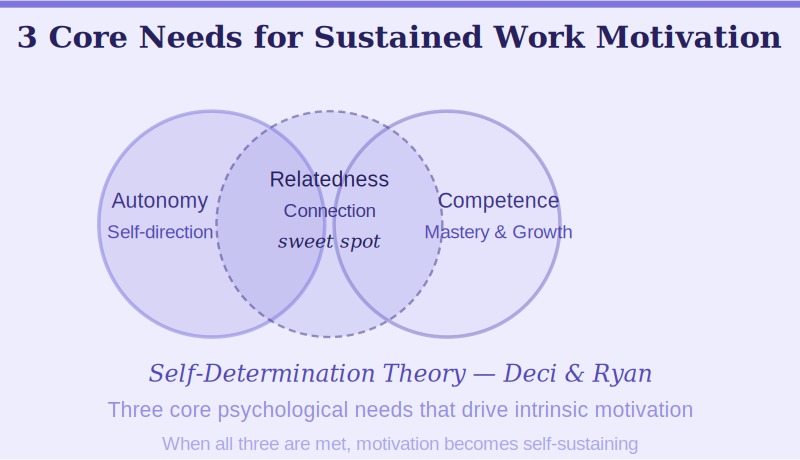
Lack of autonomy is one of the strongest predictors of disengagement. Self-Determination Theory, developed by psychologists Edward Deci and Richard Ryan, identifies autonomy, competence, and relatedness as the three core psychological needs that drive sustained motivation. When any of these is chronically unmet — when you feel micromanaged, stagnant, or isolated — motivation erodes systematically.
Unclear goals are another major driver. A study published in the Harvard Business Review found that progress — specifically the feeling of making meaningful forward movement — is the single most powerful motivator in daily work life. Without clear goals, there is no progress to measure and no sense of momentum to sustain.
Chronic stress and burnout are the final frontier. The World Health Organization officially classified burnout as an occupational phenomenon in 2019, describing it as a syndrome resulting from chronic workplace stress that has not been successfully managed. Burnout and motivation cannot coexist — addressing one requires addressing the other.
The Real Cost of Low Workplace Motivation
This is not just a personal problem. Gallup estimates that low employee engagement costs the global economy approximately $8.8 trillion per year — equivalent to 9% of global GDP. For individuals, chronic disengagement is linked to higher rates of anxiety, depression, and physical health problems according to research published in the Journal of Occupational Health Psychology.
Understanding the stakes makes the strategies below more than productivity tips — they are investments in your wellbeing and your career.
12 Proven Strategies to Stay Motivated at Work
1. Connect Your Work to a Larger Purpose
The most durable motivation comes from meaning, not money. A landmark study by Adam Grant at Wharton Business School showed that workers who understood how their efforts benefited others were significantly more persistent and productive — even when the work itself was mundane.
Ask yourself: who does your work ultimately help? A customer who saves time, a colleague who relies on your output, a product that solves a real problem. Mapping your daily tasks to a human impact — however small — reliably rekindles motivation that external rewards cannot sustain.
2. Set Clear, Meaningful Goals Using the OKR Framework
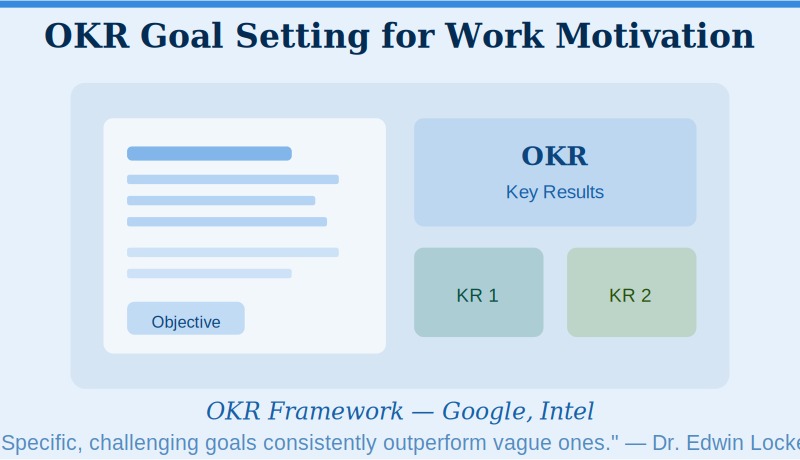
Vague intentions produce vague effort. The OKR framework — Objectives and Key Results, popularized by Google and Intel — gives your work a measurable direction. An Objective answers “what do I want to achieve?” while Key Results answer “how will I know I’ve achieved it?”
Research from Dr. Edwin Locke’s Goal-Setting Theory — one of the most replicated findings in organizational psychology — demonstrates that specific, challenging goals consistently produce higher performance than vague or easy ones. Set weekly objectives every Monday morning, review them on Friday, and adjust as needed.
3. Use the Progress Principle
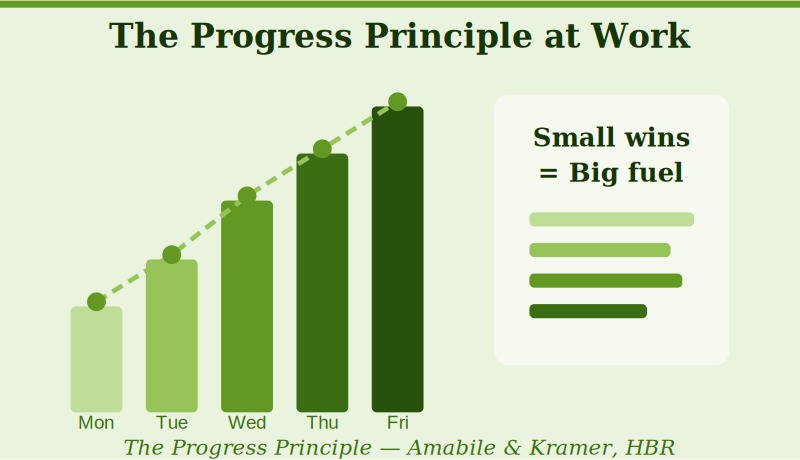
Teresa Amabile and Steven Kramer’s research, summarized in The Progress Principle (Harvard Business Review Press), analyzed nearly 12,000 diary entries from knowledge workers and found that the single strongest motivator on any given workday was making progress on meaningful work — even a small win.
Practically, this means breaking large projects into visible milestones. Finish a section. Ship a small feature. Complete a draft. Each completion triggers a dopamine response that fuels motivation for the next step. A task list that lets you cross things off is not trivial — it is neuroscience in action.
4. Build Autonomy Into Your Day
If your organization allows it, design your own schedule around your peak energy. Daniel Pink’s research in Drive identifies autonomy as the foundational element of intrinsic motivation. Even small acts of self-direction — choosing the order of your tasks, working from a different location one day a week, or setting your own mini-deadlines — measurably increase engagement.
Talk to your manager about flexible arrangements. Research from Stanford economist Nicholas Bloom found that remote and hybrid workers who have schedule flexibility report significantly higher job satisfaction and motivation without any loss in productivity.
5. Master Your Energy, Not Just Your Time
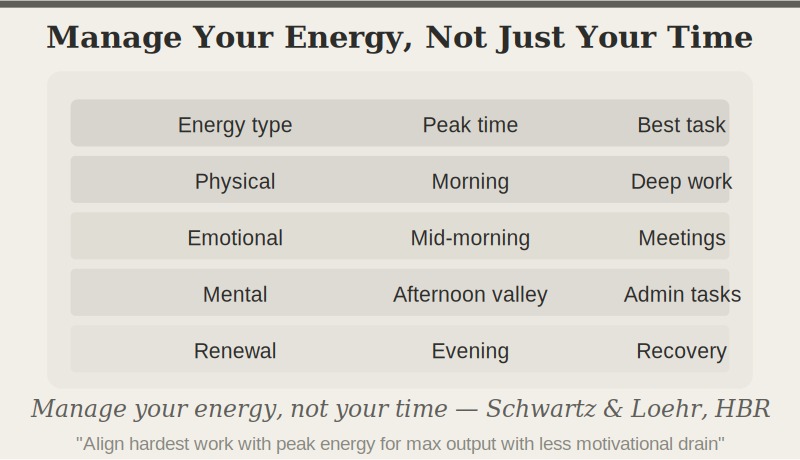
Time management alone does not sustain motivation. Tony Schwartz and Jim Loehr’s research, published in Harvard Business Review, argues that managing your physical, emotional, mental, and spiritual energy is far more important than managing your calendar.
In practice, this means aligning your most cognitively demanding work with your biological peak — typically mid-morning for most people, according to chronobiology research by Michael Breus. Schedule shallow work, meetings, and administrative tasks during your natural energy valleys. The result is higher quality output with less motivational drain.
6. Cultivate a “Growth Mindset” at Work
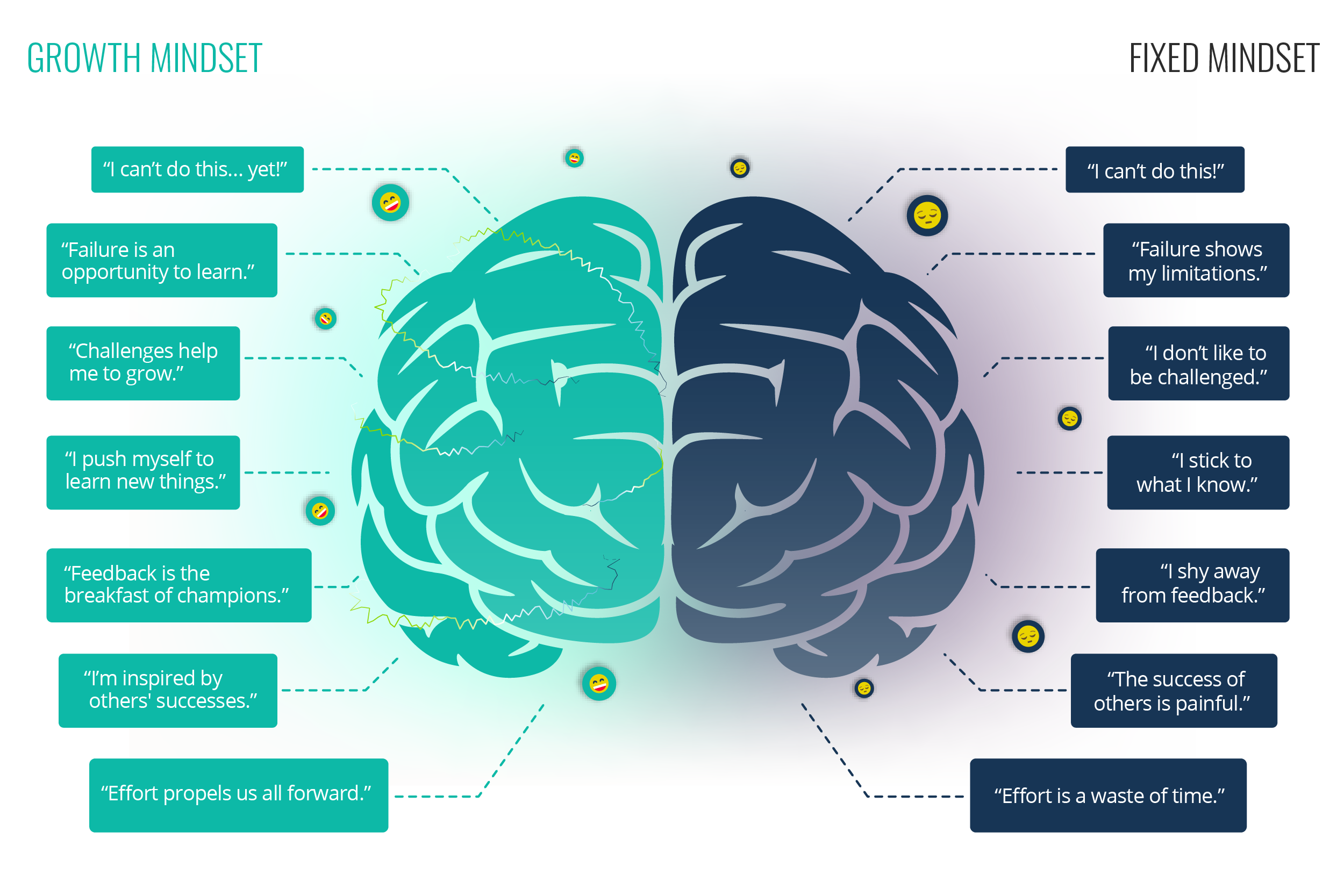
Carol Dweck’s research on mindset at Stanford University draws a sharp line between a fixed mindset — the belief that abilities are static — and a growth mindset — the belief that effort leads to improvement. People with a growth mindset approach setbacks as learning opportunities rather than evidence of inadequacy, which keeps motivation intact through difficulty.
To build a growth mindset at work: treat every mistake as a data point, seek feedback actively rather than avoiding it, and frame challenges as skill-building opportunities. This cognitive reframing is not wishful thinking — it is a trainable mental habit with decades of empirical support behind it.

7. Reduce Friction and Decision Fatigue
Research by Roy Baumeister on ego depletion demonstrates that willpower and motivation are finite daily resources. Every unnecessary decision — what to work on next, where your files are, which task is the priority — drains the reservoir.
To stay motivated at work, reduce friction: organize your workspace the night before, use a consistent daily routine, batch similar tasks together, and automate or delegate repetitive decisions wherever possible. The cognitive bandwidth you save goes directly toward sustained engagement with your most important work.
8. Leverage Social Connection and Accountability
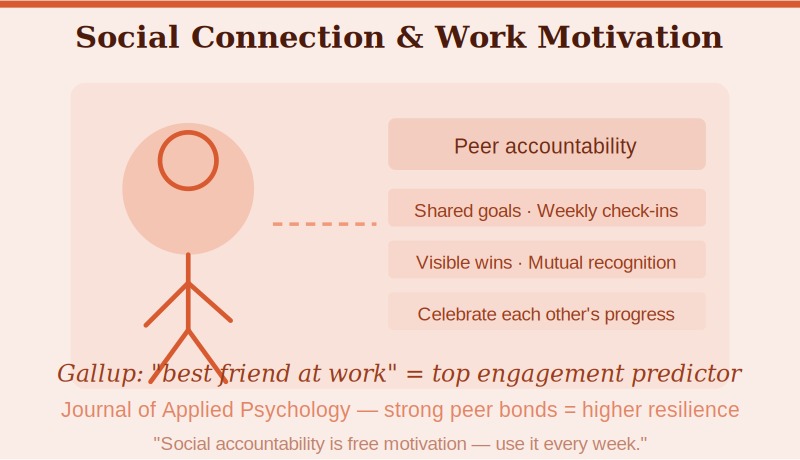
Humans are deeply social creatures, and workplace relationships are powerful motivational levers. Research published in the Journal of Applied Psychology found that employees with strong peer relationships at work report higher engagement, greater resilience under stress, and longer tenure.
Find an accountability partner — a colleague you check in with weekly about goals and progress. Share your objectives with your team. Celebrate other people’s wins visibly. Gallup’s research consistently shows that having a “best friend at work” is one of the top predictors of employee engagement — a finding that has held up across cultures and industries for over two decades.
9. Reward Yourself Deliberately
Intrinsic motivation is more durable, but extrinsic rewards still play a role — especially for tasks that are not inherently engaging. The key is making rewards specific, immediate, and proportional. Research in behavioral economics by Dan Ariely shows that unexpected, symbolic rewards often outperform large bonuses in sustaining motivation, because they signal recognition rather than transactional exchange.
Build personal reward structures: finish the quarterly report before treating yourself to lunch at your favorite spot. Complete a difficult client call before taking a ten-minute walk. Small, consistent positive reinforcement keeps the motivational loop running even through uninspiring stretches.
10. Prioritize Rest and Recovery
This is counterintuitive but critical: trying harder is often the worst thing you can do when motivation is low. Research from the National Sleep Foundation directly links sleep deprivation to decreased motivation, impaired decision-making, and increased emotional reactivity. The same applies to overwork.
Microsoft’s 2022 Work Trend Index found that employees who take regular breaks, use their vacation time, and disconnect after hours show significantly higher long-term engagement than those who do not. Sustainable motivation requires sustainable recovery. Protecting your rest is not laziness — it is maintenance.

11. Seek Challenges That Match Your Skills — The Flow State
Psychologist Mihaly Csikszentmihalyi’s concept of flow — the state of complete absorption in a challenging, meaningful task — is one of the most reliable sources of intrinsic work motivation. Flow occurs at the intersection of high skill and high challenge. Tasks that are too easy produce boredom; tasks that are too hard produce anxiety. Neither sustains motivation.
Audit your workload: are you being sufficiently challenged? If not, proactively ask for stretch assignments, take on a project outside your comfort zone, or teach a skill to a junior colleague. If the challenge is overwhelming, seek mentorship or break the task into smaller components. Calibrating difficulty to capability is one of the most powerful levers for staying motivated at work.

12. Address the Root Cause — Have the Difficult Conversation
Sometimes motivation is low because something at work is genuinely broken — a dysfunctional team, an unsupportive manager, or a role that no longer fits. In those cases, no amount of individual strategy will substitute for structural change.
Research published in MIT Sloan Management Review identified toxic workplace culture as the number one predictor of employee attrition during the Great Resignation — ten times more predictive than compensation. If your environment is actively hostile to motivation, the most strategic action is to name the problem directly with your manager, HR, or — if necessary — to begin exploring roles that are better aligned with your needs.
How to Stay Motivated at Work During Difficult Periods
Even with the best systems in place, motivation will dip. The goal is not to eliminate slumps but to shorten them. When motivation is genuinely low, these approaches help.
Return to your “why.” Reread your job description or your original goals. Talk to someone your work has helped. Reconnecting with purpose is faster and more effective than forcing productivity.
Lower the activation energy. Commit to just ten minutes on the task you are avoiding. The Zeigarnik Effect, documented by Soviet psychologist Bluma Zeigarnik, shows that starting an incomplete task creates cognitive tension that actually pulls you toward completion.
Change your physical environment. Research published in the Journal of Environmental Psychology shows that even minor environmental changes — moving to a different desk, going outside for ten minutes, changing your background music — measurably reset cognitive engagement.
Acknowledge the slump without judgment. Self-compassion research by Kristin Neff at the University of Texas shows that people who treat themselves kindly after a motivational dip return to full engagement faster than those who respond with self-criticism.
Frequently Asked Questions
How do I stay motivated at work when I hate my job? Distinguish between situational dissatisfaction and chronic misalignment. Situational issues — a difficult project, a conflict with a colleague — can usually be addressed with the strategies above. Chronic misalignment — values, role, or environment — requires a more fundamental change. If the job itself is incompatible with your needs and values, motivation strategies are temporary patches. Long-term wellbeing may require a career change.
What are the most common reasons for losing motivation at work? According to Gallup’s research, the top drivers of disengagement are: unclear expectations, lack of recognition, insufficient development opportunities, weak manager relationships, and a sense that one’s opinions do not matter. Identifying which of these applies to your situation allows you to address the cause rather than the symptom.
Can motivation be trained or is it a personality trait? Motivation is substantially trainable. While personality factors like conscientiousness influence baseline motivation, research on habit formation, mindset, and behavioral design all confirm that systematic environmental and cognitive changes reliably increase motivational output over time.
How long does it take to rebuild motivation after burnout? Recovery from burnout varies widely. A 2021 review in the Journal of Occupational Health found that mild burnout recovery typically takes weeks to a few months with proper rest and support, while severe burnout can require six months to two years. Early intervention — before burnout becomes clinical — dramatically shortens recovery time.
The Bottom Line: Building a Motivation System That Lasts
Staying motivated at work is not about finding a magic spark and hoping it never goes out. It is about building a system — of goals, habits, relationships, recovery, and meaning — that generates motivation reliably, even on the days when inspiration is nowhere to be found.
The strategies above are not about working harder. They are about working in a way that aligns with how human psychology actually functions: driven by purpose, sustained by progress, nourished by connection, and protected by rest.
Start with one change this week. Pick the strategy that addresses your most pressing friction point. Implement it consistently for thirty days. Then add another. Motivation compounds — the same way interest does — when you give it the right conditions.
Further reading: