
Last Updated on 23/10/2026
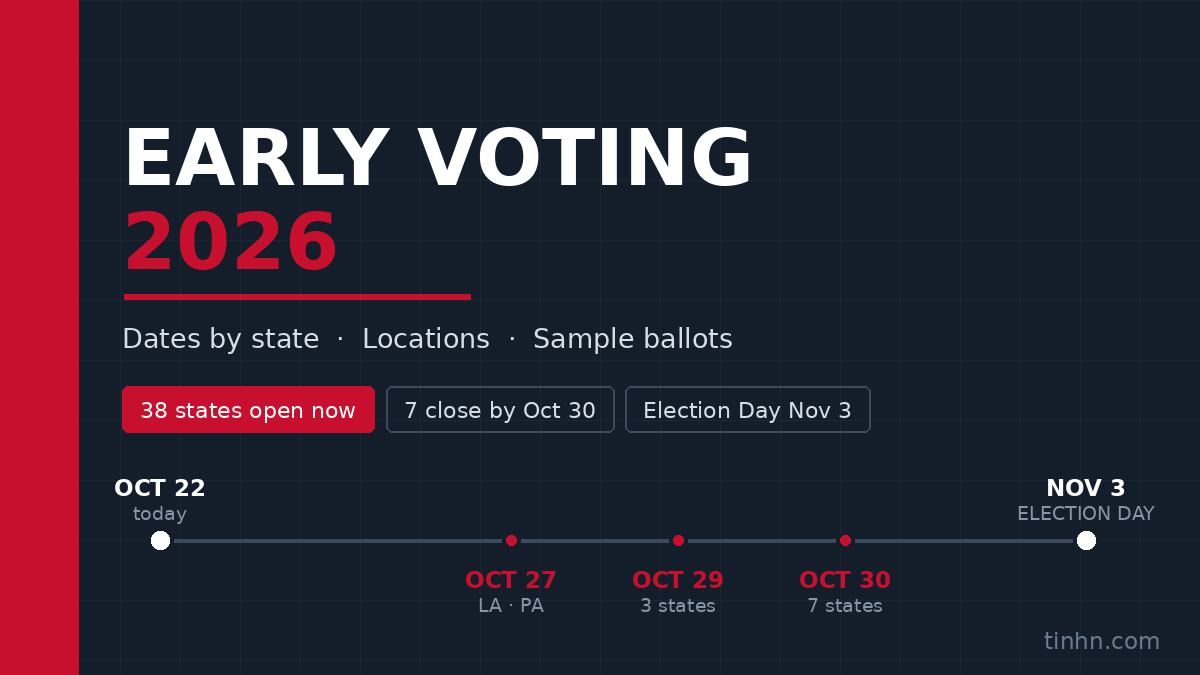
Looking for early voting locations by zip code? Early voting 2026 is already under way. Election Day is Tuesday, November 3, 2026 — but in 38 states you do not have to wait that long. Early in-person voting is open right now.
In six more states plus Washington, D.C., it opens within the next week. And in a handful of states it closes much sooner than people expect — Louisiana and Pennsylvania both stop early voting on October 27, a full week before Election Day.
This page covers the three things people actually ask in the last two weeks of a campaign: when early voting 2026 runs in each state, how to find your polling place and your sample ballot, and what identification you need to bring.
Quick answers
| Question | Answer |
|---|---|
| When is Election Day 2026? | Tuesday, November 3, 2026 |
| Is early voting 2026 open now? | Yes, in 38 states as of October 22 |
| Which states have no early in-person voting? | Alabama, Mississippi, New Hampshire, Oregon |
| Earliest closing dates | Louisiana and Pennsylvania, October 27 |
| How do I find early voting locations by zip code? | Your state election office, or a national lookup tool |
Is early voting 2026 open in my state right now?
Already open (38 states)
Alaska · Arizona · Arkansas · California · Colorado · Connecticut · Delaware · Georgia · Hawaii · Idaho · Illinois · Indiana · Iowa · Kansas · Louisiana · Maine · Maryland · Massachusetts · Minnesota · Missouri · Montana · Nebraska · Nevada · New Mexico · North Carolina · Ohio · Rhode Island · South Carolina · South Dakota · Tennessee · Texas · Utah · Vermont · Virginia · Washington · West Virginia · Wisconsin · Wyoming
Opening soon
| State | Early voting begins |
|---|---|
| Florida | October 24 |
| Michigan | October 24 |
| New Jersey | October 24 |
| New York | October 24 |
| Washington, D.C. | October 26 |
| Oklahoma | October 28 |
| Kentucky | October 29 |
Dates set locally
North Dakota and Pennsylvania set early voting at the county or local level, so there is no single statewide start date. Pennsylvania’s statewide cutoff is October 27. Check with your county election office.
Early voting 2026 dates by state
| State | Begins | Ends |
|---|---|---|
| Alabama | None | — |
| Alaska | Oct 19 | Nov 3 |
| Arizona | Oct 7 | Oct 30 |
| Arkansas | Oct 19 | Nov 2 |
| California | Oct 5 | Nov 2 |
| Colorado | Oct 19 | Nov 3 |
| Connecticut | Oct 19 | Nov 1 |
| Delaware | Oct 22 | Nov 1 |
| District of Columbia | Oct 26 | Nov 1 |
| Florida | Oct 24 | Oct 31 |
| Georgia | Oct 13 | Oct 30 |
| Hawaii | Oct 20 | Nov 3 |
| Idaho | Oct 13 | Oct 30 |
| Illinois | Sept 24 | Nov 2 |
| Indiana | Oct 6 | Nov 2 |
| Iowa | Oct 14 | Nov 2 |
| Kansas | Oct 14 | Nov 2 |
| Kentucky | Oct 29 | Oct 31 |
| Louisiana | Oct 20 | Oct 27 |
| Maine | Oct 5 | Oct 29 |
| Maryland | Oct 22 | Oct 29 |
| Massachusetts | Oct 17 | Oct 30 |
| Michigan | Oct 24 | Nov 1 |
| Minnesota | Sept 18 | Nov 2 |
| Mississippi | None | — |
| Missouri | Oct 20 | Nov 2 |
| Montana | Oct 5 | Nov 2 |
| Nebraska | Oct 5 | Nov 2 |
| Nevada | Oct 17 | Oct 30 |
| New Hampshire | None | — |
| New Jersey | Oct 24 | Nov 1 |
| New Mexico | Oct 6 | Oct 31 |
| New York | Oct 24 | Nov 1 |
| North Carolina | Oct 15 | Oct 31 |
| North Dakota | Varies | Varies |
| Ohio | Oct 6 | Nov 1 |
| Oklahoma | Oct 28 | Oct 31 |
| Oregon | None | — |
| Pennsylvania | Varies | Oct 27 |
| Rhode Island | Oct 14 | Nov 2 |
| South Carolina | Oct 19 | Oct 31 |
| South Dakota | Sept 18 | Nov 2 |
| Tennessee | Oct 14 | Oct 29 |
| Texas | Oct 19 | Oct 30 |
| Utah | Oct 20 | Oct 30 |
| Vermont | Sept 19 | Nov 2 |
| Virginia | Sept 18 | Oct 31 |
| Washington | Oct 16 | Nov 3 |
| West Virginia | Oct 21 | Oct 31 |
| Wisconsin | Oct 20 | Nov 1 |
| Wyoming | Oct 6 | Nov 2 |
Early voting 2026 dates compiled from Ballotpedia. Local hours and locations still vary within every state, and a few jurisdictions change schedules late. Confirm with your county or state election office before you travel.
Closing first: seven states where the window shuts within a week
If you live in one of these, early voting 2026 ends before the weekend before Election Day.
| Closes | States |
|---|---|
| October 27 | Louisiana, Pennsylvania |
| October 29 | Maine, Maryland, Tennessee |
| October 30 | Arizona, Georgia, Idaho, Massachusetts, Nevada, Texas, Utah |
A common and costly assumption is that early voting runs right up to Election Day. In most states it does not. Louisiana shuts it seven days out.
The four states without early in-person voting
Alabama, Mississippi and New Hampshire do not offer early in-person voting for any voter who wants it. All three allow absentee voting, but you need a qualifying excuse — illness, absence from the county, work conflict, age or disability, depending on the state.
Oregon is a different case. It has no early voting polling places because it does not have polling places at all. Every registered voter is mailed a ballot. You can return it by mail or drop it at an official drop box, which is effectively voting early.
This distinction matters: “no early voting” in Oregon means the state already went further, not less far.
States that vote primarily by mail
In these states every registered voter is mailed a ballot automatically:
California · Colorado · Hawaii · Nevada · Oregon · Utah · Vermont · Washington · Washington, D.C.
Most of them still run in-person vote centers for people who need them — which is why several of these states appear in the table above with early voting dates. Being a mail state and having in-person early voting are not mutually exclusive.
How to find early voting locations by zip code
There is no national database of polling places, because elections in the United States are run by counties, not by the federal government. That is the honest answer to “early voting locations by zip code” — the lookup has to happen locally, and no single page can hold every address.
Three reliable routes, in order:
1. Your state or county election office. This is the authoritative source and the only one guaranteed current. Search for your state’s Secretary of State elections page, or your county board of elections.
2. Vote.org and similar nonpartisan tools let you enter your address and route you to the right local information. Useful as a starting point.
3. USA.gov’s voting section links out to every state’s official election site from one page.
Be careful with sponsored search results in the last two weeks before an election. Official election offices use .gov domains in most states. If a site asks you to pay for voter registration or ballot information, it is not an official source.
Sample ballot by zip code: what it is and how to get yours
A sample ballot is an exact copy of the ballot you will receive, showing every race and ballot measure you personally will vote on. Because it is built from your precinct, a sample ballot by zip code is the closest thing to seeing your real ballot before you vote.
It matters more than most people assume. The top of the ballot gets all the attention, but a midterm ballot typically runs much longer: state legislature, judges, county offices, school boards, and ballot measures written in dense legal language. Voters who arrive without having read these either skip them or guess.
Where to get yours:
- Most county election offices publish sample ballots online a few weeks before the election, searchable by address or precinct
- Many states mail a voter information pamphlet that includes the ballot measures with arguments for and against
- Nonpartisan tools like Ballotpedia’s sample ballot lookup assemble the same information from public records
Print it, or open it on your phone while you are in the booth — this is permitted in most states, though a few restrict phone use at the polls.
What ID do I need to vote?
According to the National Conference of State Legislatures, 36 states have laws requesting or requiring voters to show some form of identification at the polls. The other states verify identity by other means, usually a signature match against your registration record.
The important distinction is not photo versus non-photo. It is strict versus non-strict:
- In non-strict states, a voter without ID can still cast a regular ballot — by signing an affidavit, having an election official verify their identity, or presenting an accepted alternative document.
- In strict states, a voter without qualifying ID casts a provisional ballot, which only counts if they return with acceptable ID by a deadline. Those deadlines range from the same day in Missouri to the Friday after the election in Alabama and Wisconsin.
Several states also accept a “reasonable impediment” declaration — a signed statement explaining why you could not obtain ID. Texas and South Carolina are examples.
Because the rules differ in meaningful detail from state to state, check the NCSL voter ID table or your state election office for your specific requirements.
Early voting or mail ballot: which should you use?
| Early in-person | Mail ballot | |
|---|---|---|
| Deadline risk | Low — you are done when you leave | Higher — must arrive by your state’s deadline |
| Ballot problems | Fixed on the spot by poll workers | May require a separate “cure” process |
| Lines | Usually much shorter than Election Day | None |
| Window | Days to weeks, closes before Election Day in most states | Request and return deadlines, often earlier |
Among people who use early voting 2026 in person, the vote is recorded the moment they leave. The most common way a vote fails to count is a mail ballot that arrives late or has a signature problem the voter never learns about. If you already have a mail ballot and have not sent it, many states let you drop it at an official box or an election office rather than trusting the postal timeline.
Frequently asked questions
When is Election Day 2026?
Tuesday, November 3, 2026. Federal Election Day is always the Tuesday after the first Monday in November.
How do I find early voting locations by zip code?
Enter your home address on your state or county election office site, or on a nonpartisan tool such as Vote.org. Zip codes can span more than one precinct, so a full address returns a more accurate result than a zip code alone.
When does early voting 2026 end in my state?
It varies widely. Louisiana and Pennsylvania close on October 27, seven days before Election Day. Alaska, Colorado, Hawaii and Washington run right through November 3. Check the table above, then confirm with your county office.
Can I still register to vote?
It depends on your state. Some closed registration weeks ago; about 20 states plus D.C. offer same-day registration, letting you register and vote at the same time during early voting or on Election Day. Check your state’s rules immediately — this is the deadline people miss most often.
Does voting early mean my vote is counted earlier?
Not necessarily. States differ on when they may begin processing and counting early and mail ballots. Some start well before Election Day; others cannot open envelopes until polls close, which is a major reason results in those states take longer.
Can I change my vote after voting early?
In almost all states, no. Once your ballot is cast it is final. A small number of states allow a mail ballot to be replaced before it is processed, but in-person early votes are irreversible.
What if the line is long when polls close?
In every state, if you are in line when polls close, you are entitled to vote. Do not leave the line.
Where do I find results on election night?
Results come from state and county election offices, reported by the Associated Press and major networks. Expect close races to remain uncalled for days in states that cannot begin counting mail ballots early.
Related reading
- 2026 US Midterm Elections: Date, 10 Senate Races to Watch
- 2026 Midterm Senate Map: All 10 Competitive Races
- 2026 California Governor Race: Steve Hilton vs. Xavier Becerra
Sources
- Ballotpedia, Early voting dates, 2026
- National Conference of State Legislatures, Early In-Person Voting
- National Conference of State Legislatures, Voter ID Laws