
Last Updated on 14/06/2026
World Cup 2026 format explained — discover how 48 teams, 12 groups, the new Round of 32, tiebreaker rules, and the best third-place system all work in football’s biggest-ever tournament.
🔴 Now Live: The first-ever 48-team World Cup kicked off on June 11, 2026 with Mexico vs South Africa at Estadio Azteca. Everything explained below — the 12 groups, the new Round of 32, and the third-place qualification rules — is now playing out in real time. The third-place rankings in particular will become decisive in the final group matchdays (June 24–27).
Introduction: Why the 2026 Format Is a Historic Shift
The 2026 FIFA World Cup is not just bigger than any previous edition — it is structurally different in ways that affect every match, every strategy, and every fan experience from day one. For the first time since 1998, FIFA has fundamentally redesigned the tournament, expanding from 32 teams to 48, increasing the total matches from 64 to 104, and adding an entirely new knockout round that has never existed before.
Hosted across 16 venues in the United States, Canada, and Mexico from June 11 to July 19, 2026, this edition spans 39 days — longer than any World Cup in history. Whether you’re a lifelong football fan, a first-time viewer, or someone filling out a bracket predictor, understanding the new format is essential before the opening whistle.
This guide breaks down every component of the 2026 World Cup format: the group stage, tiebreakers, the best third-place rule, the new Round of 32, the full knockout bracket, and what it all means for the teams competing.
- Review the official World Cup Fixtures 2026 to see the rest days and travel distances.
The Big Picture: How the 2026 World Cup Format Works
Here is the complete structure of the tournament at a glance:
| Stage | Teams | Matches |
|---|---|---|
| Group Stage (12 groups × 4 teams) | 48 | 72 |
| Round of 32 | 32 | 16 |
| Round of 16 | 16 | 8 |
| Quarterfinals | 8 | 4 |
| Semifinals | 4 | 2 |
| Third-place play-off | 2 | 1 |
| Final | 2 | 1 |
| TOTAL | — | 104 |
The journey from Group Stage to champion now requires a team to win up to 7 matches — one more than in the 32-team format used between 1998 and 2022, according to William Hill.
Part 1: The Group Stage — 12 Groups of Four
How the Group Stage Works
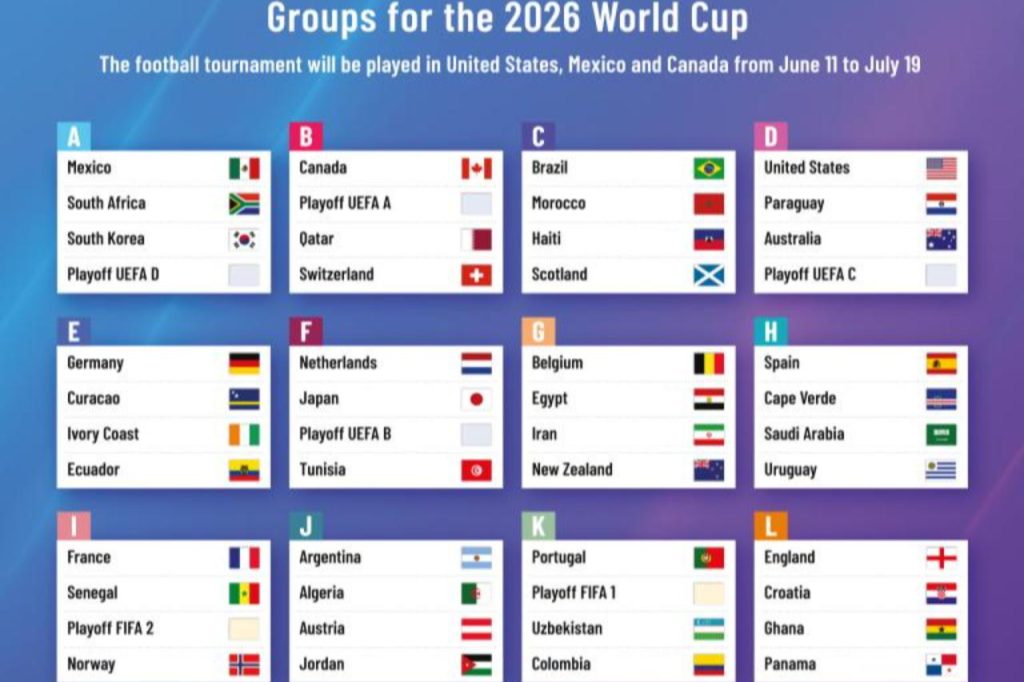
The 48 qualified nations are divided into 12 groups (A through L), each containing 4 teams. Every team plays the other three sides in its group exactly once — a round-robin format — giving each nation exactly 3 guaranteed matches regardless of results, according to ESPN.
Points are awarded as follows:
- Win: 3 points
- Draw: 1 point
- Loss: 0 points
This is identical to past World Cups. What changes is what happens after the group stage ends.
Who Advances from the Group Stage?
Under the 2026 format, 32 of the 48 teams advance to the knockout rounds. This breaks down as:
- ✅ 12 group winners — the team finishing 1st in each group
- ✅ 12 group runners-up — the team finishing 2nd in each group
- ✅ 8 best third-place teams — selected from the 12 third-place finishers across all groups (see Part 2)
This means 4 teams are eliminated at the group stage — the bottom-ranked (4th-place) finisher from each of the 12 groups.
Key takeaway: Under the old 32-team format, finishing 3rd meant immediate elimination. In 2026, finishing 3rd can still earn you a place in the knockout rounds — as long as your record is among the best 8 third-place performances across all 12 groups.
Part 2: Tiebreakers — How Group Standings Are Decided
When two or more teams in the same group finish level on points, the following official FIFA tiebreaker sequence is applied in order:
Tiebreakers for 3+ Teams Tied on Points
- Most points earned in head-to-head matches among the tied teams
- Superior goal difference in head-to-head matches among the tied teams
- Most goals scored in head-to-head matches among the tied teams
- Superior goal difference across all group matches
- Most goals scored across all group matches
- Highest fair play (conduct) score — calculated as:
- Yellow card: −1 point
- Indirect red card (second yellow): −3 points
- Direct red card: −4 points
- Yellow card + direct red card: −5 points
- FIFA world ranking
Tiebreakers for 2 Teams Tied on Points
For a two-team tie (after head-to-head results have been checked), criteria 4–7 above apply directly.
Historical example: At the 2018 World Cup, Japan advanced ahead of Senegal on fair play — both sides were level on points, goal difference, and goals scored, but Japan had accumulated fewer yellow cards. That exact scenario can recur in 2026.
Part 3: The Best Third-Place Rule — How 8 of 12 Advance
This is the most complex — and most dramatic — new element of the 2026 format.
After all 12 groups are completed, 12 teams will have finished in third place. Only 8 of these 12 advance to the Round of 32. To determine which 8 progress, all 12 third-place teams are ranked against each other using these criteria (in order):
- Points
- Goal difference (all 3 group matches)
- Goals scored (all 3 group matches)
- Fair play score
- FIFA world ranking
What This Means Tactically
Because goal difference is the primary separator after points, a team that earns 3 points from a single win will fight hard to maximize their margin of victory. A 4-0 win ranks significantly higher than a 1-0 win when competing against 11 other third-place finishers across different groups.
A team that loses its first two group matches can still advance by winning Match 3. The third-place rule means no team is mathematically dead until the final group match is played.
Where Do the 8 Third-Place Teams Go in the Bracket?
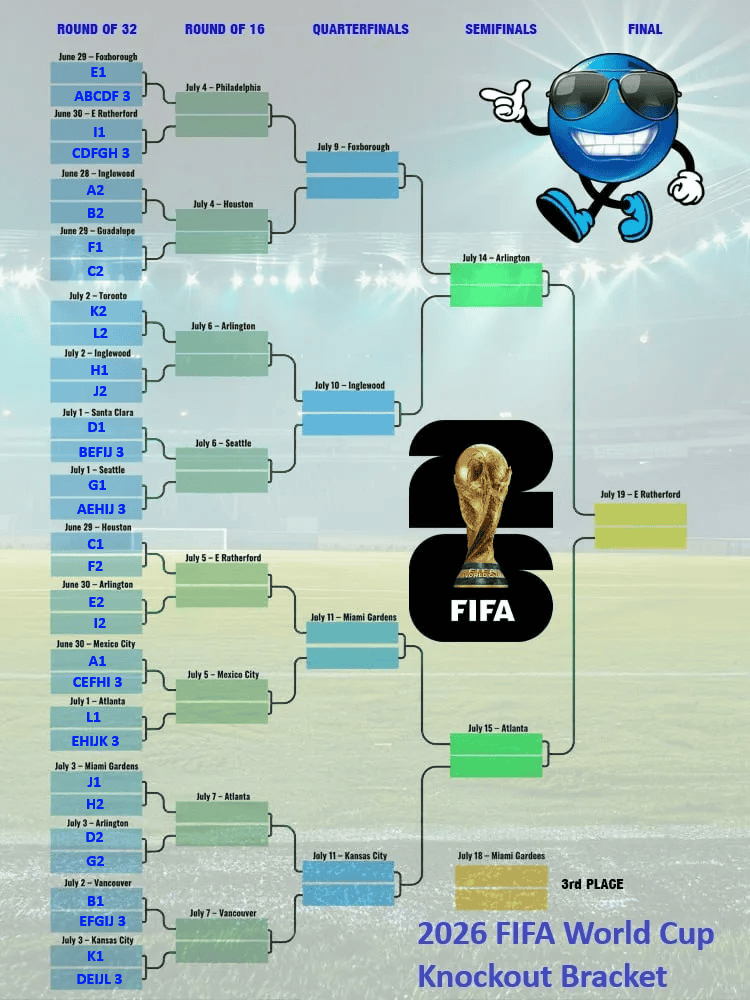
Once the 8 best third-place teams are identified, their bracket slots are determined by FIFA’s Annex C rules — a pre-set allocation table that assigns third-place teams to specific Round of 32 matchups based on which groups they came from. This ensures bracket balance and avoids scheduling conflicts.
- Check out the full World Cup Bracket 2026 to map out the knockout stages.
Part 4: The New Round of 32 — Football’s New First Knockout Round
The Round of 32 is the most visible structural innovation of the 2026 format. It has never existed at a men’s FIFA World Cup before.
Under the old system (1998–2022), 16 teams entered the Round of 16 directly from the group stage. In 2026, 32 teams enter the first knockout round, creating an entirely new layer of do-or-die football.
Round of 32 Rules
- Single-elimination: one match decides who advances
- If level after 90 minutes → extra time (2 × 15 minutes)
- If still level → penalty shootout
- No second legs, no away goals rule
The Round of 32 features 16 matches played across multiple venues, typically over 4–5 days. Winners advance to the Round of 16; losers go home.
Part 5: The Full Knockout Bracket — From Round of 32 to the Final
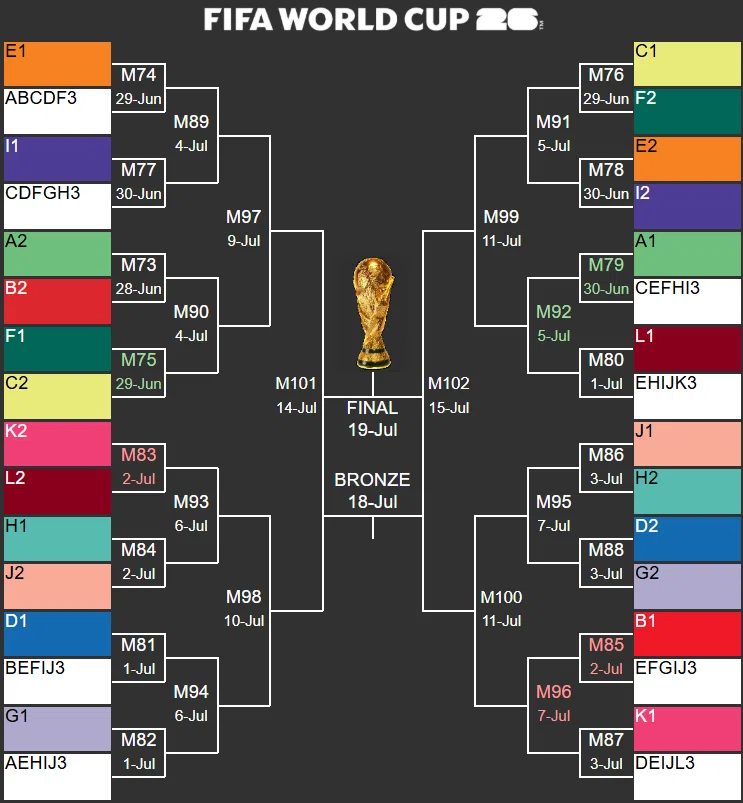
Once the Round of 32 is complete, the tournament follows classic single-elimination knockout format:
Round of 32 (32 teams → 16 teams)
       ↓
Round of 16 (16 teams → 8 teams)
       ↓
Quarterfinals (8 teams → 4 teams)
       ↓
Semifinals (4 teams → 2 teams)
       ↓
Final + Third-place play-off
Every match from the Round of 32 onward uses the same extra time + penalties structure if scores are level after 90 minutes.
Key Knockout Stage Dates
| Round | Approximate Dates |
|---|---|
| Round of 32 | June 29 – July 4, 2026 |
| Round of 16 | July 5–8, 2026 |
| Quarterfinals | July 10–11, 2026 |
| Semifinals | July 14–15, 2026 |
| Third-place play-off | July 18, 2026 |
| World Cup Final | July 19, 2026 — MetLife Stadium, New Jersey |
Part 6: How the 2026 Format Compares to Previous World Cups
| Feature | 1994–1998 (32 teams) | 2026 (48 teams) |
|---|---|---|
| Teams | 32 | 48 |
| Groups | 8 groups of 4 | 12 groups of 4 |
| Matches | 64 | 104 |
| Group stage matches | 48 | 72 |
| Teams advancing | 16 | 32 |
| First knockout round | Round of 16 | Round of 32 (NEW) |
| Matches to win the title | 7 | 7 (same) |
| Tournament length | ~32 days | 39 days |
| Host nations | 1 | 3 (USA, Canada, Mexico) |
Note: Despite the field doubling in size, a team still needs to win exactly 7 matches to lift the trophy — because the new Round of 32 effectively replaces the lost group-stage knockout pressure.
Why Was the 32-Team Format Changed?
FIFA voted to expand to 48 teams in January 2017. The official reasons include:
- Greater global inclusion — more spots for Africa, Asia, Oceania, and CONCACAF
- Commercial growth — more matches means significantly more broadcast and sponsorship revenue
- Development of football in new markets — particularly North America ahead of the 2026 co-hosted tournament
- Accessible qualification — smaller nations have a more realistic path to the World Cup
Why Not 16 Groups of Three?
FIFA initially proposed 16 groups of three teams, which would have meant each team only played 2 group matches. This format attracted criticism because:
- Teams would know exactly what they needed in Match 2 (the final group game), increasing the risk of collusive results
- Only 2 guaranteed matches per team felt insufficient for the world’s biggest tournament
- Simultaneous final group games — which prevent collusion — would be impossible with 3-team groups
FIFA ultimately chose 12 groups of four, preserving the 3-match guarantee and the familiar World Cup rhythm.
Part 7: What the 2026 Format Means for Teams and Tactics
For Strong Nations (Top 10 FIFA Rankings)
Top seeds face an extra knockout match they previously didn’t. Managing squad rotation, avoiding injuries, and maintaining peak form across potentially 7–8 matches (if factoring pre-tournament friendlies and travel) becomes more critical than ever.
For Mid-Tier Nations
The expanded format is the biggest gift mid-ranking nations have ever received. Finishing third in a group — which used to mean going home — now keeps you alive. A team ranked between 30th and 60th in the world has a realistic shot at reaching the Round of 16 even if they lose one group match.
For Debut and Returning Nations
For the four 2026 debutants — Cape Verde, Curaçao, Jordan, and Uzbekistan — the third-place rule is transformative. A single group-stage win could be enough to advance, depending on how other groups play out.
For Players
The extended tournament (39 days, up to 7 matches) combined with the 16-venue spread across three nations adds travel fatigue and scheduling complexity. Squad depth — especially in central midfield and the goalkeeper position — will be a decisive factor.
Part 8: Arguments For and Against the 2026 Format
✅ The Case For the New Format
- Global representation: Nations from every corner of the globe now have a genuinely accessible path to the World Cup. FIFA expanded slots for Africa (to 9), Asia (to 8), and Oceania (first guaranteed direct spot)
- More football: 104 matches means more drama, more upsets, and more content for fans across 39 days
- Third-place survival: The “best third-place” rule keeps more teams fighting until the very last group match, reducing dead-rubber games
- Commercial strength: FIFA’s revenue projections for 2026 far exceed previous editions, funding football development globally
❌ The Case Against the New Format
- Dilution of quality: Critics argue that adding 16 lower-ranked nations will produce more lopsided group matches — large winning margins that may not be competitive entertainment
- Player fatigue: Top players arriving from club seasons that already end in late May face a grueling 7-match gauntlet on top of an already congested calendar
- Complexity: The “best third-place” system confuses casual fans, and FIFA’s Annex C bracket allocation rules require significant explanation
- Travel demands: Three host nations spanning thousands of miles mean some teams could travel over 10,000 km between group matches
Frequently Asked Questions: World Cup 2026 Format
How many teams are in the 2026 World Cup?
48 teams — up from 32 in every edition between 1998 and 2022. This is the first expansion in 28 years.
How many groups are there in the 2026 World Cup?
12 groups (A through L), each with 4 teams. Each team plays 3 group matches.
How many teams advance from the group stage?
32 teams: the top 2 from each of the 12 groups (24 teams) plus the 8 best third-place finishers.
What is the Round of 32?
A brand-new knockout round, introduced for the first time in World Cup history. 32 teams compete in single-elimination matches before the Round of 16 begins.
What are the World Cup 2026 tiebreaker rules?
First, head-to-head points among tied teams. Then head-to-head goal difference, then goals scored. If still tied: overall goal difference, overall goals scored, fair play score, and finally FIFA ranking.
Can a team finish third in their group and still advance?
Yes. The 8 best third-place finishers across all 12 groups advance to the Round of 32. This is determined by points, goal difference, goals scored, fair play score, and FIFA ranking.
How many matches are there in the 2026 World Cup?
104 total matches: 72 in the group stage and 32 in the knockout rounds.
How long is the 2026 World Cup?
39 days, from June 11 to July 19, 2026.
Where is the 2026 World Cup Final?
MetLife Stadium in East Rutherford, New Jersey, USA — on July 19, 2026.
How many matches does a team need to win the 2026 World Cup?
7 matches — the same as in the 32-team format, because the new Round of 32 replaces one stage while removing direct group-stage elimination.
Conclusion: A New Era for the World’s Biggest Tournament
The 2026 FIFA World Cup format represents the most significant restructuring of football’s premier event since France 1998. By expanding to 48 teams and introducing the Round of 32, FIFA has created a tournament that is more inclusive, more commercially powerful, and more tactically complex than any previous edition.
Whether you see it as an evolution that opens football to the world, or a dilution of the tournament’s elite drama, one thing is certain: the 2026 format will produce moments, upsets, and storylines that could never have existed in the 32-team era. More teams mean more stories. More matches mean more chances for the unexpected.
The tournament kicks off on June 11, 2026, with Mexico hosting South Africa at Estadio Azteca. The final is 39 days later at MetLife Stadium — and the path to that final has never been longer, more complex, or more open to every nation on Earth.
Last updated: May 27, 2026. All format data verified against official FIFA regulations.
- See deep-dives for all 48 nations in our World Cup Teams 2026 guide.